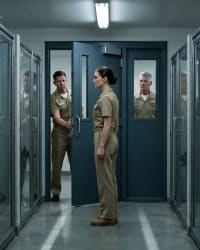
At five the next morning, Kemp came through the kitchen door wearing an apron.
The dining hall was still dark beyond the serving line. A few ceiling lights shone over the stainless counters, and the coffee urns waited cold at the back.
Inez was already there, tying her own apron at the waist.
Kemp stopped just inside the doorway. The apron strings hung loose behind him.
“Those need to be tied before you start,” she said.
He reached back and knotted them. Then he stood waiting.
Inez pointed toward the sink. “Wash your hands. Then come to the prep counter.”
He did as she asked. Water ran hard against the steel basin.
The portrait was dim above the corner table. Its frame caught a narrow line of light from the kitchen.
The plaque below it was too small to read from where Kemp stood.
Inez did not look toward it. She laid out cutting boards and pans.
“Today we’re setting up breakfast,” she said. “You’ll follow the posted list.”
He nodded once.
She showed him where the clean pans were stacked and where the vegetables waited.
He carried each item to the counter without rushing. The apron shifted as he leaned.
“Keep the labels facing forward,” Inez told him.
He turned the cans so their labels faced the aisle.
The instruction sheet listed quantities and serving times. He read each line before opening a container.
Inez checked the first pan he filled. She corrected the level with a spoon.
“Same amount in each pan,” she said.
“Yes, ma’am.”
He began again, measuring more carefully.
The kitchen had its own morning rhythm. A refrigerator hummed beneath the clatter of utensils.
Steam began gathering at the serving line as the ovens warmed.
Inez moved between the counter and stove. She checked temperatures and shifted pans into place.
Kemp watched her hands, then the task in front of him.
The work offered no audience. The other soldiers had not yet entered.
He peeled vegetables, rinsed them, and carried them to the cutting board.
Inez showed him how to hold the knife safely. He adjusted his grip.
She did not ask what he thought about the assignment. He did not explain himself.
They worked with the few words the work required.
“More onions,” she said.
He brought another container.
“Set them beside the board.”
He moved it closer.
The portrait stayed in the corner of his vision whenever he looked up. He kept his eyes on the vegetables.
By the time the first soldiers arrived, the serving line was ready.
The hall brightened under the windows. Pale morning light spread across the laminate tables.
Steel chairs scraped as people sat down. Conversation rose in short bursts.
Inez took her position at the first pan. Kemp stood at the next station, ready with serving utensils.
A soldier held out a tray.
“Eggs, please.”
Kemp served a measured portion. The soldier moved along the line.
Another tray followed. Then another.
Inez kept the line moving without hurrying anyone. She asked one soldier if he wanted fruit.
The soldier nodded. She added it to his tray.
Kemp watched the plates pass, checking that no serving pan ran low.
When one began to empty, he replaced it with a full pan from the warmer.
Inez saw him check the temperature before setting it down.
“Good,” she said. “Keep the fresh pan behind the one in service.”
He shifted it into place.
Nobody stopped at Kemp’s station to ask about his apron. Nobody mentioned the corner table.
The trays kept coming. Serving utensils clicked against steel.
Inez greeted the soldiers who greeted her. She answered questions about the meal.
She did not tell anyone what the plaque said. She did not need to.
The portrait looked out over the room from its place above the corner table.
At the end of the rush, the line thinned. A few soldiers lingered over coffee.
Inez wiped the serving counter. Kemp gathered the empty pans.
“Bring those to the wash station,” she said.
He carried them carefully, keeping the stack level.
The private who had raised her phone during the incident was among the diners that morning. She sat with the others and ate.
She did not approach Inez or Kemp. She did not take out her phone.
The squad sat at a table farther down the hall. Their voices stayed low enough to blend with the room.
They had seen Kemp flip the tray. They had laughed when he called Inez the help.
They had also watched him turn toward the plaque and read.
Inez did not study their faces. She kept wiping the counter until it was clean.
The breakfast work moved on to dishes and floors.
Kemp scraped the pans and stacked them for washing. He rinsed each one before passing it along.
Inez checked the rack and moved one pan so it sat flat.
“Water has to reach the whole surface,” she said.
He turned it.
When the rack was full, he pushed it into the washer.
The machine started with a heavy rush. Hot water and steam softened the kitchen air.
Inez took a moment to drink from a cup. Then she checked the next meal’s preparation list.
Kemp wiped the wash station and replaced the towels.
He looked across the hall. The corner table stood empty under the portrait.
A few grains of breakfast cereal remained beneath one chair. He swept them into a dustpan.
He carried the dustpan to the bin and returned it to its hook.
The work kept him moving from one small task to another.
Inez gave him clear instructions. He followed them without speaking over her.
When he finished early, he waited beside the counter.
“There are clean trays in the rack,” Inez said. “Stack them by the line.”
He did that next.
The trays were beige plastic, all alike. They slid together with a hollow click.
He set them down in even stacks.
The sound was ordinary. Still, each tray brought back the one he had sent to the floor.
Inez saw his hands pause once. She said nothing.
He continued stacking.
A cook from the morning shift passed through to pick up a pan. Inez gave him the pan and checked the count on her list.
She did not introduce Kemp or explain why he was there.
The kitchen had work to finish before lunch. The next delivery needed checking and putting away.
Inez read the quantities against the sheet. Kemp carried sealed boxes to the storage shelves.
“Keep the older stock in front,” she said.
He rearranged the boxes.
She showed him how to check the date on each container. He moved the older ones forward.
The routine repeated itself: lift, read, place, count.
The dining hall filled and emptied in waves. The kitchen stayed busy between them.
At lunch, the corner table filled with soldiers. They carried trays past the portrait without looking up.
Inez served from the same line she had prepared that morning.
Kemp kept each portion level. He replaced pans before they ran empty.
When a soldier asked for an extra roll, he looked to Inez.
“Give him one,” she said.
Kemp placed it on the tray.
The soldier thanked him and moved on.
The hall’s familiar sounds rose around them. Forks tapped trays; chairs shifted on tile.
Steam clouded the windows nearest the serving line.
Inez checked the coffee urns and made sure there was enough for the tables.
Kemp wiped a spill before anyone stepped in it.
He brought a clean cloth, then dried the tile until it no longer shone.
At the end of lunch, he gathered trays from the return counter.
He carried them in stacks small enough to manage. No tray tipped or struck the floor.
Inez worked beside him, sorting utensils and clearing food scraps.
The private passed through the line with an empty tray. She set it on the counter.
Kemp took it and placed it on the stack. She left without looking back.
There was no conversation about the phone. Its screen remained out of sight.
Inez did not ask what it had captured. The answer would not change what the room had already witnessed.
After the lunch rush, the dining hall quieted. The serving line needed another cleaning.
Kemp washed the counters, then checked for crumbs along the edges.
He moved the chairs far enough to sweep beneath the tables.
At the corner, he stopped beside the table where he had stood over Inez.
He swept beneath it, including the place where the tray had landed.
The floor was clean. He went on to the next table.
Inez brought a fresh cloth and wiped the table’s edge.
She did not take the corner seat. She had work to finish.
The portrait above them held the same calm expression it had in the morning.
Its subject wore a dark jacket and had short hair. A thin scar crossed her left eyebrow.
The glass of the shadow box caught light from the windows. The bronze medal rested behind it.
Kemp looked up once, then lowered his eyes to the table.
He moved the chairs back into place.
The lunch routine continued the next day.
Kemp arrived at five in the same apron. He tied it before Inez had to remind him.
She handed him the preparation list. He read it and began with the first task.
The work did not change because the day did. Breakfast still needed cooking.
Soldiers still came through the line. Trays still needed washing.
Inez kept her attention on the food and the people waiting for it.
Kemp learned where each tool belonged. He returned things to their places.
He learned to rinse a pan as soon as it was empty. He learned to watch the serving levels.
When he made a portion too large, Inez showed him the proper measure.
He corrected the next one.
On another morning, he set out the clean trays before the first diners arrived.
On another, he noticed the coffee urn was nearly empty and refilled it.
Inez continued to tell him what the kitchen needed. She did not soften the work or make it harder.
The assignment had a clear length: thirty days. Each shift began with the same practical instructions.
He would prepare, serve, and clean. He would do the work in the place where he had humiliated her.
No speech could shorten the days. No apology would erase the lunch that began them.
For the first several shifts, Kemp kept his answers short.
“Yes, ma’am.”
“I understand.”
“I’ll fix it.”
He did not ask Inez to call him by another name or rank.
She called him Kemp when she needed his attention.
“Move that pan, Kemp.”
He moved it.
“Bring the clean utensils over.”
He brought them.
She had chosen to keep the kitchen running. The soldiers needed meals whether the hall was comfortable or not.
That was the rule she had lived by before the incident. It remained the rule afterward.
She did not make the men wait while the room discussed what had happened.
When the line slowed, she watched for empty trays and warm food.
When someone looked uncertain, she pointed out where to go.
“Sit down and eat before it gets cold,” she told a soldier carrying his tray toward the end of the hall.
He found a seat.
Kemp heard the words from his station. He kept serving.
The corner table became occupied again every day. It was a table like the others now.
Sometimes soldiers sat there and talked about ordinary things. Sometimes it stayed empty until lunch was nearly over.
Nobody needed to claim it for the squad.
Kemp did not stand over it again.
The portrait and plaque stayed where they were. Their place on the wall did not change.
Diners passed beneath them, some glancing at the frame, many focused on their trays.
Inez did not demand that they stop. The hall’s name had been there before them.
The portrait showed the woman she had been at twenty-six. It did not show the years that came after.
It did not show the night at the outpost or the trips to the aid bunker.
It did not show her return to the hall as a civilian kitchen manager.
Those facts were engraved on the plaque, behind its small brass surface.
Inez did not repeat them to the people in line. She had never wanted meal service to become a ceremony.
The kitchen stayed the center of her attention.
A soup pot needed stirring. A warmer needed checking. A delivery needed counting.
The work gave her somewhere to put her hands.
Kemp kept showing up. He did not miss a shift.
He worked through breakfast, lunch, cleanup, and the preparation in between.
When dishes piled up, he washed them. When floors needed sweeping, he swept them.
When trays came back, he stacked them without letting them slide.
The beige trays no longer made him pause.
He lifted each one from the return counter and placed it on the rack.
The line moved around him, steady and unremarkable.
The squad still ate in the hall. Their table changed from day to day.
They saw Kemp serving food in an apron. They saw him clean the counters after service.
They did not gather around him or make a show of watching.
Their earlier laughter remained part of the room’s memory, whether anyone spoke of it or not.
The private came through the line on some of those days. She ate with the others.
Her phone stayed put away. No one asked her about the footage.
No one could say whether she had recorded the full incident or kept anything afterward.
That remained her choice, outside the work in Inez’s kitchen.
Inez gave no instructions about it. The matter did not need a new story attached.
Kemp did not ask her what the private had saved.
He did not ask whether the squad had talked about him. He did not ask what the diners thought.
At the kitchen counter, there was always another pan to move.
Near the middle of the assignment, a lunch rush lasted longer than usual.
The serving line stayed crowded, and steam rose steadily from the pans.
Inez kept serving. Kemp watched the trays and the portions.
A pan ran low just as another group reached the counter. He brought a replacement from the warmer.
He set it down, then moved the nearly empty pan away.
“Thank you,” Inez said.
He nodded and returned to his station.
The line kept moving.
At the end, Kemp gathered the remaining trays. Inez counted the clean utensils.
They finished without leaving a mess for the next shift.
It was not a remarkable day. That was part of what the assignment required.
The work asked for care on days when no one praised it.
It asked for consistency when the room was busy and when it was nearly empty.
Kemp began to anticipate the ordinary needs. He set out serving spoons before Inez asked.
He checked the warmer before taking a pan to the line.
He slowed down when a soldier’s tray was crowded, so nothing spilled.
Those changes did not undo the incident. They were simply things he did differently.
Inez noticed, but she did not call them proof of anything.
She kept correcting mistakes and acknowledging finished work.
One afternoon, Kemp wiped the corner table after the diners left.
The portrait hung directly above him. The plaque caught the light from the windows.
He dried the table’s edge and pushed the chairs in.
Then he picked up a stray napkin from the floor.
He carried it to the bin and returned to the kitchen.
Inez was checking a list beside the counter.
“Those chairs are back in place,” he said.
She glanced toward the corner. “I see that.”
He waited a moment, then took the next stack of trays.
There was no promise between them. There was only the next task.
As the days passed, his movements grew more assured. He knew the route between storage, prep, and the line.
He still checked with Inez before changing a task. The kitchen was hers to manage.
She did not ask him to lead. She asked him to work.
The food went out on time. The tables were cleared. The floors were swept.
The hall opened each morning with the same pale green walls and rows of tables.
The portrait remained above the corner seat.
People came in hungry and left with empty trays. The day continued.
By the final week, Kemp no longer needed reminders about the apron.
He arrived early, tied it, washed his hands, and checked the list.
If Inez had already started, he joined the work in front of him.
He cut vegetables, filled pans, and set clean trays at the line.
When she gave a correction, he made it without an argument.
He did not turn the assignment into a performance. He did not ask anyone to notice.
The squad saw him at work, as they had seen him at the table that Tuesday.
That was enough. Their opinions remained their own.
Whitaker’s decision followed the public incident and was carried out through the ordinary schedule of the hall.
Kemp no longer led his squad. His name was off the promotion list.
For thirty days, he reported to the kitchen and did the work Inez assigned.
Those consequences did not require her to supervise his feelings.
She had meals to prepare.
On the last morning of the assignment, Kemp arrived at five.
He wore the apron and tied it himself.
The dining hall was quiet. The portrait looked down over the corner table.
Inez checked the breakfast list. Kemp read it beside her.
“Start with the pans on the lower rack,” she said.
He lifted them out and carried them to the counter.
They prepared breakfast as they had on the other mornings.
He set out the clean trays. She checked the warmer.
The first soldiers arrived before the line was fully bright with daylight.
Inez greeted them and began serving. Kemp took his place at the next station.
One soldier asked for eggs. Kemp served a portion and passed the tray along.
Another asked for fruit. He added some and moved the tray forward.
The line continued, orderly and quick.
When the rush eased, Kemp gathered the used pans and carried them to the wash station.
He rinsed them, loaded the rack, and started the washer.
Inez wiped down the serving counter. She checked the remaining food and covered the pans.
The room grew quieter as the soldiers returned to their duties.
Kemp swept beneath the tables and pushed in the chairs.
He reached the corner table and wiped its surface clean.
Above him, Inez’s portrait remained fixed in its frame. The brass plaque and medal case stayed beside it.
He finished and returned to the kitchen.
Inez handed him a clean tray from the rack.
He stacked it with the others.
The assignment had reached its last day. The hall still needed lunch.
Inez put the morning list away and checked the next one.
Kemp followed her instructions through the rest of the shift.
They prepared food, set the line, served the diners, and washed the pans.
He carried each tray back from the return counter.
No tray hit the floor.
When the work was finished, the kitchen was clean and ready for the next meal.
Kemp untied his apron and folded it.
Inez looked over the counters and the stacked pans.
“Everything’s put away,” she said.
“Yes.”
She nodded toward the door. “You’re finished with the assignment.”
He placed the apron where she indicated.
He did not ask her to say more. She did not offer an absolution.
He walked out of the kitchen and into the hall.
Inez stayed behind to check the next meal’s supplies.
The portrait was visible from the serving line. It had been there before the incident and would remain there afterward.
The name Delgado Hall stayed above the entrance.
The soldiers who came through still needed hot meals. Inez continued to make sure they got them.
At the corner table, a pair of diners sat down with their trays.
They began eating while the food was warm.
Inez returned to the kitchen and started the next list.
Kemp had completed the thirty days. The harm he caused remained part of the room’s history.
The work had given him no easy way around it. It had asked him to show up, serve, and clean.
Inez had kept doing what she chose: feeding soldiers and being left to her work.
Whitaker had made his decision about command and promotion. Kemp had carried out the assignment.
The portrait stayed on the wall, above a table that belonged to whoever sat there.
Was Whitaker right to take Kemp’s squad away, or should one bad lunch not cost a man his stripes?