Kemp’s eyes stopped on the plaque.
His mouth stayed set for a moment, but the smirk was gone.
The small brass plate carried the name above the table. The lines beneath it were too small for anyone across the room to read.
Kemp read them at close range. Then he read them again.
He had passed the portrait twice a day for five months. Now he stood close enough to see the face it showed: Inez at twenty-six, with the same thin scar through her left eyebrow.
Behind him, a chair leg scraped across the tile.
Whitaker had risen beside the coffee urns. His cup sat on the table where he had left it.
He stood with both hands at his sides and looked toward the corner table.
The room seemed to wait for someone to explain what the portrait already showed.
Inez kept her hairnet in one hand. She did not turn toward Whitaker.
Kemp looked back at her. His jaw worked, then stopped.
The private stared at the screen, her smile gone. No one at her table spoke.
No one called out. The laughter had ended, but its place was not empty.
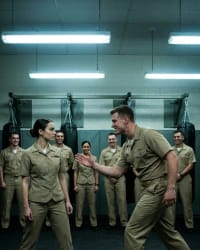
The room had heard Kemp tell Inez to move. It had heard him call her “the help.”
His squad had laughed. A private had raised a phone.
Now Kemp had read the plaque, and every table could see his face.
Whitaker’s voice crossed the hall, deep and clear.
“On your feet. All of you.”
The first chairs moved near the coffee urns.
Then the sound traveled down the rows. Steel legs scraped tile, some at once, some a beat later.
Soldiers pushed back from tables and stood beside them. A few looked toward Whitaker; others faced the corner.
The order changed the room’s posture in a breath. Forks paused above plates; conversations stopped.
Kemp remained by the spilled lunch.
For a moment, he seemed to have forgotten where to put his hands.
His squad stood behind him, no longer grinning. The young woman lowered her phone to her chest.
Kemp looked toward his squad, but no one met his eyes.
Kemp straightened, but not all the way.
Inez watched him without moving. Her lunch lay scattered between his boots and the table.
Whitaker began walking.
The soldiers held their places as he passed. The hall gave him a clear path between the tables.
His steps were measured, neither rushed nor slow. He passed steam rising from the serving line and the coffee urns.
The portrait waited above the corner table. The bronze medal in its shadow box caught a bar of window light.
Whitaker stopped in front of Inez.
He stood squarely, as he had stood in uniform beside her years before.
“Master Sergeant Delgado,” he said, loud enough for the back tables. “Sorry about your lunch.”
His words settled into the quiet.
A soldier near the serving line glanced at the portrait. Another looked down at the tiles.
Inez held the hairnet by its elastic edge. Her other hand rested at her side.
“Thank you, Command Sergeant Major.”
Whitaker gave a small nod. His eyes moved to the tray and the food.
He had named what had happened in front of the room. He did not speak for the men who had laughed.
He did not turn the apology into a speech about Inez’s service. She had not asked for one.
“Everybody sit down and eat before it gets cold.”
No one moved at first.
Then Whitaker turned slightly toward the hall and repeated the instruction with a gesture.
“Sit. Eat.”
Chairs came forward again, row by row. The clatter was softer than before.
People returned to their places. Some picked up forks; others looked toward the corner table before doing so.
The room had not gone back to its earlier noise. The serving line still hissed, and a coffee urn clicked as it cooled.
Inez bent to pick up her tray.
Kemp reached it first.
He crouched and gathered the beige plastic tray with both hands. A smear of potatoes clung to one corner.
He set the carton of milk upright. It had dented on one side but had not opened.
Green beans and mashed potatoes remained on the floor. The fork lay several feet away.
Kemp reached for it. His fingers paused above the handle.
Inez still held her hairnet. She did not tell him to stop.
He picked up the fork and placed it on the tray. Then he began collecting what he could.
A piece of bread had landed near a table leg. He leaned over and picked it up.
The private’s phone was no longer raised. She had not put it away.
Kemp placed the bread on the tray. His hands moved carefully, as if the objects might break.
“I’ll get you another plate,” he said.
Inez looked at the food on the floor.
“That one’s done.”
He nodded. He did not try to make an excuse.
The tray had been his to flip. Now he was the one holding it, with the lunch he had scattered.
Whitaker watched from beside the table. The room had already seen the act.
The soldiers had watched Kemp flip the tray. They had heard his words and laughed when he pointed at the portrait.
They had also watched him read the plaque.
Now they watched him gather what he had scattered.
Kemp stood with the tray in his hands. His squad remained near him, quiet and stiff.
Inez set the hairnet on the table. She reached for a napkin and wiped a small patch of sauce from her palm.
Whitaker glanced at the mess on the tiles.
“Get a mop,” he told a nearby soldier.
The soldier moved toward the service area. No one else spoke.
Kemp held the tray out toward Inez.
She took it by the edge.
Their hands did not touch.
“Thank you,” she said.
Kemp swallowed. He looked at the tray, then at the portrait above her.
“Master Sergeant,” he began.
Inez waited.
He stopped before saying more.
The hall remained open around them: long tables, steel chairs, pale green walls, and bright windows. The ordinary layout made the silence feel larger.
Inez had never meant the portrait to announce her at lunch.
She had returned to the hall because the kitchen needed a manager and she knew the work. She wanted to feed the soldiers and go home without becoming a story.
The name on the building had been there before she came back. So had the portrait and the plaque.
She had chosen not to tell people in the line who she was. Most had never asked.
Now the room knew, or had begun to understand. She could not put the information back behind the wall.
The plaque had answered Kemp’s question about the portrait. It had not changed the lunch on the floor.
Inez still had to decide what to do with the room’s attention. She could not make everyone forget what they had seen.
She did not explain the medal or the night behind it. She did not owe the tables a story before they could eat.
Whitaker did not ask her to explain herself.
He did not ask why she had stayed quiet. The answers would not change the spilled lunch.
He turned toward the soldiers at the nearest tables.
“Carry on,” he said.
The phrase sounded almost ordinary. The room resumed eating, carefully at first.
A spoon touched a bowl. A chair shifted. Steam rose from the serving line into the fluorescent light.
Whitaker stayed beside Inez while the mop arrived.
The soldier pushed it across the tile where the food had fallen. He worked around Kemp’s boots.
Kemp stepped aside.
His squad had begun to move toward their table. They were still watching him.
He had wanted an audience. He had gotten one.
The private lowered her phone and looked at the screen. She did not show it to anyone.
No one knew whether she had recorded the whole incident or only part of it. No one asked.
Whitaker saw the phone, but he did not address the private.
He looked back at Kemp.
“Your squad. Have them finish lunch.”
Kemp turned to the four soldiers.
“Sit down,” he told them.
They returned to their table. One of them moved a chair out for the private.
Kemp stayed standing.
The squad had been part of the audience he wanted. Now they had watched him read the plaque, gather the tray, and stand without speaking.
Whitaker’s gaze moved from the tray in Inez’s hands to the portrait. The medal sat behind glass, small and plain against its dark ribbon.
He knew the story behind it. The room had only just learned the name attached to it.
The plaque did not make the tray lighter. It did not erase the insult.
Inez set the damaged tray on the corner table. She went toward the serving line.
“I can bring you a fresh lunch,” said a cook at the counter.
“Please.”
The cook placed a plate on the pass-through shelf. Inez waited while he added potatoes, green beans, and a fresh carton of milk.
She took the plate herself.
Behind her, Kemp remained near the table as the mop moved over the tile.
Whitaker had not yet told him what would happen. The room had heard no ruling.
Inez returned to her seat beneath the portrait. The chair stood where she had left it.
She placed the plate down and pulled the chair in.
The first bite was lukewarm.
She ate it anyway.
The hall was slowly finding its usual rhythm. Trays slid along the serving line, and people spoke in low voices.
At the table behind her, a soldier asked for salt. Someone passed it over.
No one called attention to the portrait. No one said the name aloud.
Inez could feel people looking, then looking away. She kept eating.
Whitaker took the chair opposite her only after she nodded toward it.
He sat without removing his gaze from the far side of the hall. His untouched coffee remained beside the urns.
“I should have stopped it sooner,” he said.
Inez set down her fork.
“You were at the back.”
“I saw the tray go.”
She looked at him. His hands rested on the table, fingers open.
“You came when you understood what he was reading.”
Whitaker did not answer immediately.
He had known Inez in the Army. He had also seen a squad leader use his position to make a show of humiliating a worker.
The plaque had made the connection plain to the room. It had not created the conduct.
“I’m going to deal with him,” he said.
Inez picked up her fork again.
“Do what you need to do.”
“I will.”
She did not ask him to name a consequence. She did not ask him to make the room apologize.
Her choice to keep her service private had not been a request for special treatment. She had wanted to work, serve lunch, and be left alone.
Now the incident had made her past public at the table where she ate. Whitaker’s decision belonged to him.
He looked at the lunch she had been given.
“Is it all right?”
“It’s food.”
That was all she said. She took another bite.
He let the silence stand. Across the room, Kemp had returned to his squad’s table, but he did not sit.
The soldiers ate. He kept his hands at his sides.
The private’s phone rested on the table beside her tray. Her thumb moved once over the screen, then stopped.
Inez did not turn around to watch.
She had finished enough of her lunch to feel the edge of her appetite return. The room’s noise had come back in pieces.
She could hear forks against plates and the low hum of conversation. A chair scraped; someone laughed at another table, then quieted.
The mop bucket rolled toward the service area. The soldier had cleaned the tile.
The beige tray was still on the corner table, empty except for the dented milk carton and fork.
Kemp had not picked up his own lunch. His squad had eaten theirs.
Whitaker rose from the chair.
“I’ll see you this afternoon,” he said.
Inez nodded.
He crossed back toward the coffee urns. His cup was still where he had left it.
He lifted it and poured fresh coffee. Then he stood for a moment, looking across the hall.
The portrait, the plaque, and the shadow box were visible from where he stood. So was the table where Kemp had made his claim.
Whitaker had a decision to make. It was not whether the plaque was true.
It was whether a squad leader who used his authority to stage a public humiliation should keep leading that squad.
The answer could not be settled by the medal or by the hall’s name. It had to follow from what Kemp had done in front of his soldiers.
Whitaker watched the squad return to their meal. Kemp stood at its end.
The promotion list was on his mind too. A recommendation meant trust in a soldier’s judgment, not merely a record of years served.
Kemp had wanted the corner table and an audience. His own squad had been the audience.
Whitaker knew the men would remember what he did next. They had already seen what Kemp did.
He drank from the cup. Then he set it down again.
In the corner, Inez ate the last of her lunch. She folded the napkin once and placed it beside the plate.
She had the kitchen to run. The serving line would remain busy for another hour.
She returned her tray to the collection rack and tied the hairnet back on. The elastic caught briefly at her left ear.
A cook called from the counter. Inez turned toward the kitchen.
The portrait remained above the corner table. Its younger face looked forward, quiet and unchanged.
By the time the lunch period began to thin, the room had resumed its tasks. Soldiers carried trays; cooks wiped the counter; the mop dried against the wall.
Kemp’s squad left together. He followed a few steps behind them.
Whitaker spoke to him near the exit. Their voices were too low for the tables to hear.
Kemp stood straight and listened. He did not argue or look toward the squad.
Whitaker pointed toward the corridor, then back into the hall. Kemp nodded once.
The conversation ended there. No one in the dining room heard more.
Inez continued through the afternoon shift. She checked the serving line and restocked the milk cartons.
When the last of the lunch crowd passed, she wiped down the counter. The kitchen had its familiar warmth and clatter again.
She washed her hands and looked through the service window. The corner table was clear.
The tray had been returned to the rack. A faint mark remained on the tile where the potatoes had landed.
She asked a cook to check it once more. He did.
There was no need to keep the mark. It was only food on a floor, and the floor needed to be clean.
The plaque remained under the portrait. The medal remained behind glass.
Inez did not read the plaque again. She knew every line on it.
That afternoon, Whitaker called Kemp into his office. The meeting was private.
No one from the hall heard the first words. No one watched from the coffee urns.
Kemp stood before Whitaker’s desk. He had no squad gathered behind him and no table to claim.
Whitaker told him the decision.
Kemp’s squad would be taken from his command. His name would come off the promotion list.
He would serve thirty days of extra duty in Inez’s kitchen.
Kemp did not dispute the order. He stood with his hands at his sides.
Whitaker made the consequences clear. The humiliation had taken place in front of the room; the response would be known to the same people.
Kemp had staged the incident for an audience. He would have to face the result in the place where he had done it.
The next morning, he would report to the kitchen. The work would be ordinary and visible.
It would not change what the room had witnessed. It would give him thirty days to answer for it through what he did.
At the end of the conversation, Whitaker gave him the duty assignment.
Thirty days. Inez’s kitchen.
That was where the decision would follow him next.