Chapter 1: The Sergeant Major’s Mug
For two weeks, Ava Calder had been the newest private at Fort Kessler.
That was the cover, and it worked because nobody expected much from a new private. She was supposed to learn the building, follow directions, and keep her head down. She did all three.
The post sat outside a town small enough to disappear between highway exits. Fort Kessler was invented, but its mess hall felt ordinary: metal tables, steel chairs, pale tile, and fluorescent panels that hummed overhead.
Ava learned which door stuck when it rained and which serving line moved fastest. She learned where the coffee ran thin and where the cooks kept the clean trays.
Those details gave her a reason to look around without making her attention seem unusual. A new soldier had to find her way through the day.
She learned the room’s rhythms without appearing to study them.
The senior NCO table stood along the mess hall’s center aisle. Senior NCOs were experienced enlisted leaders, and the table carried the sort of authority nobody had written down.
Sergeants sat there because they were expected to. New soldiers knew to ask before taking a seat. Vance made sure they remembered.
Specialist Troy Vance was not a sergeant, but he guarded the table as if someone had appointed him. He chose who could sit, who had to move, and how long a new soldier could pretend not to hear him.
The senior NCOs rarely stopped him.
Some looked up when he spoke. Others kept eating. Most seemed to accept the routine because it was easier than interrupting lunch.
Ava could not tell from a glance whether that quiet meant agreement, discomfort, or simple habit. The table gave her a place to observe, not an answer about what the people sitting there believed.
At the far end sat Sergeant Major Okafor, a heavy-set man with a shaved head and short gray stubble. He wore an olive fleece over his trousers and kept a steel coffee mug beside his tray.
He ate slowly. He rarely looked toward the center of the room.
Ava noticed him because the reports mentioned him, though not by name at first. She was at Fort Kessler to investigate complaints from three women in one unit.
They had filed against the same man. Within a month, each had withdrawn her complaint.
Before that, each had been talked to at the senior NCO table.
The reports did not tell Ava what the women had said in those conversations. They did not explain what anyone had promised, warned, or demanded. They showed a pattern and left the reasons behind it uncertain.
That uncertainty mattered. A withdrawal could have many explanations, and Ava did not know which applied to any of the three women.
She could not treat the timing as proof of what had happened in those conversations. She could treat it as a reason to ask how the conversations came about and who had been there.
Ava’s job was to find out what had happened. She could not start by announcing she was an investigator.
People talked differently when they knew who was listening. A pressed uniform and a title could turn an ordinary conversation into a guarded one.
So she arrived as a new private.
Her orders stayed folded in her breast pocket. The paper was plain on the outside, creased into thirds and kept close enough to reach quickly.
The official seal was inside.
Ava had learned not to take the paper out just to remind herself it was there. Her fingers knew its edge through the fabric.
It was a practical safeguard, not something she planned to display. Until she needed it, the orders stayed folded and out of sight.
She did not use the cover to make people trust her. She used it to keep the first conversation from ending before it began.
The mess hall was a place where people lowered their guard for ordinary reasons. They were hungry. They were tired. They wanted a seat, a hot meal, and a few quiet minutes.
Ava ate when she could. She watched where people sat and how they moved around the long tables.
The routine made the room easier to read. Trays arrived, chairs scraped, and conversations formed around whichever seats were open.
Vance appeared most often around the senior NCO table. He had a broad frame, cropped blond hair, and tan boots that clicked sharply on tile.
His smile rarely reached his eyes. It came out when someone asked a question he considered foolish, or when he had an audience.
He did not wear rank insignia that made him anyone’s superior. He did not need it at that table.
One afternoon, a new woman approached with a tray. She paused beside an open chair.
Vance leaned back and glanced at the seat.
“Not here,” he said. “Find another spot.”
She looked at the sergeants. One of them moved his fork through a pile of potatoes. Another checked his mug.
The woman took her tray toward the serving line and found a place near the wall.
Vance turned back to his food.
Nobody called him out. Nobody had to say the table belonged to him. The room had already learned the rule.
Ava watched, then looked down at her own tray.
She wrote nothing in a notebook. A private taking notes in the mess hall would invite questions she could not answer without compromising the assignment.
Instead, she carried the details in her head: who had looked up, who had not, and who had left.
That was less precise than a written account, but the assignment depended on not drawing attention. She held onto what she had seen and kept the questions separate from the answers.
The three withdrawn complaints stayed in her thoughts. She did not know those women personally, and she would not pretend to know what they felt.
She knew only that they had gone through a process and then stepped away from it. She knew somebody had spoken to each one at that table beforehand.
She wanted to understand the connection, not turn it into a conclusion before she had the facts.
That meant waiting.
The first few days brought no dramatic scene. Vance made room at the table feel like a privilege. He acted as if the privilege belonged to him.
Ava listened when soldiers spoke nearby. She let conversations pass without joining them unless someone spoke to her first.
People asked where she had come from. She gave the answer the cover required, brief and unremarkable.
They asked whether she knew anyone at the post. She said she was still learning names.
When they asked what she wanted from the Army, she kept her answer simple.
“To do the work,” she said.
It was not a lie. It was only less than the whole truth.
The orders in her pocket reminded her how little the cover changed about her actual work. She was still an investigator, responsible for examining complaints carefully.
She still had to distinguish what she had seen from what she had been told. A pattern mattered. So did the limits of what the pattern proved.
She could not let the cover make her forget why she was there, either. Listening was part of the work, even when it did not produce a quick explanation.
Nobody had asked her to decide the case before she began.
Nobody had asked her to force a particular outcome. She had come to learn what happened at the table, and why three women had withdrawn complaints.
The work would be less useful if she tried to answer those questions for them.
At the end of her first week, she saw Okafor at the far end again. A steel mug stood beside his tray, its handle turned toward his right hand.
He glanced down at the meal. He did not glance toward the table’s middle.
Vance was talking to a young soldier who stood beside an empty chair. The soldier’s tray balanced on one hand.
“Sergeants only,” Vance said.
The soldier moved away.
Okafor cut a piece of meat and kept eating.
Ava remembered the reports. The women had been talked to at that table. Okafor had been there, again and again.
She could not say he had heard every conversation. She could not say what he had understood. She could say he had never looked up.
That difference mattered. A good investigation did not make facts larger because the answer seemed obvious.
Still, absence could have weight. Sometimes the choice not to interrupt left the person doing harm with more room.
It also left the people being pushed away without a visible ally at that table. Ava could not know what they had expected from Okafor, but she could see that he had not stepped in during the moments she witnessed.
She did not know yet what Okafor would say about those years. She only knew that he had been present.
The second week began much like the first. Ava’s cover had settled into the room’s expectations.
A new private was forgettable if she followed the rules. Ava followed them until a rule was the thing she had come to understand.
She kept her posture plain and her voice level. She did not stare at Vance when he passed.
She did not make the mistake of treating restraint as safety. She was not there because the mess hall was comfortable.
She was there because the complaints did not make sense by themselves. Three women had reported the same man, then withdrawn their reports after being talked to at the same table.
The repeated setting was a reason to ask more questions. It was not an answer.
Her brother’s dog tags made the waiting harder.
They were two small pieces of steel on a thin silver chain, blank except for the marks of handling. They carried no words anyone else could read.
Sam’s tags went everywhere Ava went.
He had died in a training accident four years earlier. Ava did not bring his death into every conversation, and she did not turn it into an explanation for the choices she made.
She carried the tags because they were his. Because they were familiar. Because, some days, the small weight reminded her that someone she loved had existed beyond the hardest part of his story.
The tags were not a fix for grief. They did not make her fearless, or bring him back, or explain why the accident had happened.
They were just metal on a chain. She could hold them when she needed something solid.
She usually kept them in a pocket or in her hand when she was alone. The mess hall was not a place where she liked to bring them out.
But that week, the tags kept finding their way into her palm.
She rubbed the edges with her thumb while waiting for food. She let the chain settle around her fingers beneath the table.
She did not want anyone to notice.
On day eleven, she carried her tray to the senior NCO table.
She chose the end seat, alone.
It was a deliberate choice. She knew Vance would see it. She knew the room would notice, even if nobody said so.
She did not expect one seat to settle the questions in the reports. It would put her where she could see how Vance enforced the rule and what the people nearby did.
Her meal sat untouched. A steel tray, a scoop of food, and a cup of water. Ava let the noise continue around her as she held Sam’s tags in her open right palm.
The folded orders pressed against her chest pocket.
The fluorescent lights made the tile look almost white. A serving cart rattled near the back of the room.
At the far end of the table, Okafor ate from his tray. His mug sat by his hand.
Vance came from the aisle behind Ava. She heard his boots before she saw his shadow cross the table.
He stopped beside her chair.
Ava kept her eyes on the tags.
Vance set his right boot against the chair leg.
The chair had not moved yet.
Ava felt the small shift in the floor beneath her feet. Vance’s weight moved forward. His shoulders tightened.
The soldiers at nearby tables turned. A few had already noticed him standing over her.
Ava stayed seated.
Vance drove his boot into the chair.
The steel legs scraped sideways across tile. The chair tipped, and Ava dropped with it, landing on the floor in a seated position.
The impact knocked the breath from her for a beat. She was unhurt.
Sam’s tags flew from her open hand and struck the tiles. They slid away from her, the chain trailing behind.
The chair clattered on its side.
Someone’s fork stopped halfway to their mouth. A pair of soldiers twisted around in their seats.
Phones rose behind Vance, held upright with their backs to the room. Their screens stayed hidden.
Vance looked down at Ava.
“Wrong table, sweetheart. Sergeants only.”
He said it loudly enough for the nearby tables to hear. His voice had a mocking edge, and the words were meant to make the room laugh with him.
A few people did.
Others watched without making a sound.
Ava shifted her weight, preparing to reach for the tags. Her fingers moved across the tile.
Vance stepped forward.
His tan boot came down flat on the dog tags. The sole covered the steel pieces and pinned the chain against the floor.
Ava’s hand stopped an inch short.
The boot stayed there.
The chain was under his sole. Ava could see one small part of it near the edge of the boot, bright against the tile.
Vance leaned down toward her, one hand resting on his knee.
His face came closer to hers. Behind him, phones remained raised.
“Gonna file a complaint, Private?”
He waited for a reaction.
Ava’s other hand was already closed around the folded orders in her breast pocket. Her fingers held the edge through the fabric.
She kept her eyes on Vance.
The room’s noise had narrowed to chairs, shoes, and the low murmur of people deciding whether to look away.
At the far end, Okafor continued eating.
Ava had seen him do it before. She had watched him keep his eyes on his tray while Vance sent a new soldier elsewhere.
She had watched the room accept that silence as part of lunch.
Now the chair lay on its side. The tags were under Vance’s boot. Phones were pointed toward the scene.
Okafor still did not look up.
Ava drew the folded paper from her pocket.
She did not answer Vance. She held the orders close to her chest and stood.
The room changed when she rose. The conversations faded. Someone lowered a phone, then lifted it again.
Vance’s boot stayed on the tags. He did not look down.
Ava kept her attention on Okafor.
He had finally come over, annoyed by the noise. The steel mug remained in his hand as he stopped in front of her.
Ava held the folded orders out.
Okafor looked at the paper. He sighed, then took it from her.
He opened it with his thumb.
The embossed seal caught the fluorescent light. Okafor’s thumb moved to its raised edge.
His face changed.
“Ma’am. You’re the Inspector General’s investigator.”
His voice was low and gravelly, but the room was quiet enough to hear him.
Vance’s arms dropped from his chest. The smirk was gone.
Okafor straightened.
“Room, attention!”
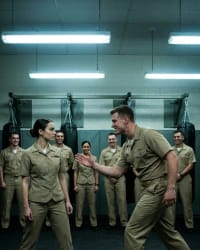
Chairs scraped back in a wave. Soldiers stood from the tables and faced Ava.
The phones came down. Boots snapped together.
Vance was the last to straighten. He stood pale and rigid beside the tags.
For two weeks, the room had treated Ava as a new private. Now every person there knew she had been investigating.
The balance had shifted, but the questions had not been answered. What Ava would say to Vance next, and what Okafor would admit before everyone, remained ahead.