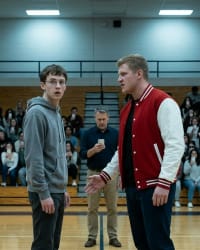
Director Caldwell stepped forward and held out his open right hand toward Garrett.
“Take off the varsity jacket and hand me your locker key, Garrett,” Director Caldwell said evenly.
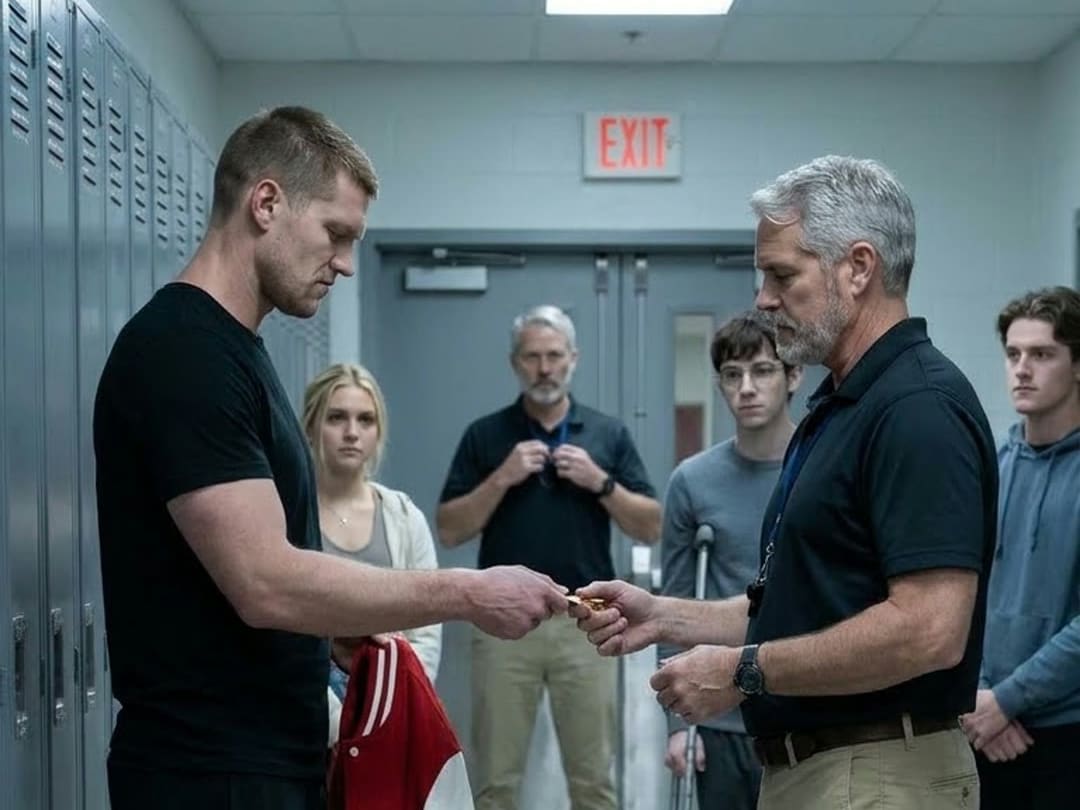
“A captain’s letter belongs to this university’s program, not to your last name.”
Garrett’s jaw trembled as he looked toward Coach Miller for help, but Coach Miller was staring down at the grey terrazzo floor, refusing to meet his eyes.
With seven teammates and three administrators watching in dead silence, Garrett slowly unsnapped the white metal buttons down the front of his crimson-and-white varsity jacket.
He slipped his arms out of the leather sleeves, folded the jacket with shaking hands, and placed it into Director Caldwell’s outstretched arm along with his brass locker key.
Without the padded varsity jacket, he suddenly looked much smaller in the fluorescent hallway light.
Garrett walked past the semicircle of players with his head down and pushed through the exit doors without saying another word.
Once the door clicked shut behind him, Director Caldwell turned his attention to Coach Harlan Miller.
“Harlan,” Director Caldwell said, his voice quiet but unmistakable in its finality, “three weeks ago you falsified a campus sports-medicine injury report to protect the starting spot of a booster’s son.”
“Today you stood ten feet away pretending to read your phone while a freshman on crutches was harassed and shoved in your hallway. And then you threatened two students with retaliation to cover it up.”
Coach Miller swallowed hard, his hand rising to the silver referee whistle hanging on his black lanyard.
“Marcus, Arthur Cole pledged four hundred thousand dollars to the athletic endowment this year,” Coach Miller said in a low, hoarse voice.
“If I benched his son for a freshman walk-on from Seattle, he threatened to pull the entire pledge before the winter board meeting.”
“And you thought a student’s knee and a freshman’s scholarship were a fair price to pay for a weight-room plaque?” Director Caldwell asked coldly.
“Remove the lanyard, Harlan, and leave your office keys on my desk on your way out of the building.”
“Assistant Coach Davis will take over varsity practice starting at four o’clock today while Human Resources prepares your termination paperwork for cause.”
Coach Miller stood frozen for a long second, looking around the locker-room corridor he had ruled for eleven seasons.
None of the players said a word in his defense.
Slowly, Coach Miller lifted the black neck lanyard over his silver-grey hair, coiled it around the metal whistle, and handed it to Director Caldwell.
He turned and walked out the same exit door Garrett had used thirty seconds earlier.
The tension in the corridor seemed to lift all at once.
Brooks bent down, picked up both of my silver aluminum forearm crutches from the terrazzo floor.
Wiped the rubber tips with his towel, and held them out to me with a respectful nod.
“Sorry we didn’t step in before he kicked those, Noah,” Brooks said honestly.
“Half of us were afraid Coach Miller would cut our minutes if we said anything against Garrett.”
“Keep them by the trainer’s rack for whoever actually needs them,” I said, shaking his hand.
“Dr. Park says I’m good to run full court today.”
Dr. Park smiled and handed Director Caldwell the signed medical clearance sheet.
Director Caldwell looked down at the paper, then looked at me through my round wire-frame glasses.
“Report to Court A in ten minutes, Mr. Vance,” Director Caldwell said.
“Coach Davis is going to need a point guard who actually knows how to hold his ground.”
That Friday morning, Garrett’s father flew in with two private attorneys and demanded an emergency meeting with the university president and the athletic board.
He walked into the conference room threatening to cancel his endowment pledge unless Garrett was reinstated as captain before the season opener.
Director Caldwell didn’t argue or raise his voice.
He simply dimmed the conference-room lights and projected both videos—the slow-motion Court A undercut and the hallway
Crutch kick—onto the ninety-inch wall screen in front of the university trustees and Garrett’s own father.
According to Dean Whitaker, Arthur Cole sat in complete silence as he watched his son kick a
Pair of crutches out from under a freshman five inches shorter and a hundred pounds lighter.
When the lights came back up, Arthur Cole dismissed his attorneys on the spot, apologized to the board.
And withdrew Garrett from the university that same afternoon so he could transfer out of state.
The board not only upheld Coach Miller’s termination for falsifying safety records, but also used the compliance audit to expand the partial scholarship fund for underclassmen.
By Monday morning, Dean Whitaker called me into his office to sign an updated financial-aid agreement that converted my partial award into a full four-year athletic and academic scholarship.
Two weeks later, on opening night in front of a packed home gymnasium, I walked out onto the hardwood for starting introductions wearing number eleven.
My right knee felt stronger than ever without the brace, and when the public-address announcer called my name as the starting freshman point guard.
The entire student section behind our bench rose to their feet.
During the two weeks leading up to the season opener, the culture inside the varsity locker room changed from the ground up under Coach Davis.
On his very first afternoon in charge, Coach Davis took down the laminated depth chart that Coach Miller had taped inside
The coaches’ office—the one that had listed players by class year and booster connections before a single drill was run.
In its place, Coach Davis taped a blank grid on the locker-room whiteboard where every minute of playing time had to be earned through defensive stops, assist-to-turnover ratios, and sprint times.
He also instituted a simple rule that nobody was allowed to bring phones out on the locker-room aisle to stage videos or mock a teammate.
Surprisingly, the players who responded best to the change were the same upperclassmen who had stood in Garrett’s semicircle with their phones.
Without Garrett holding his father’s influence over the roster and Coach Miller protecting his favorites, the guys who actually wanted to win basketball games finally started playing as a unit.
Brooks, the sophomore guard who had handed his phone to Dean Whitaker in the hallway, became my backcourt partner on the starting unit.
We spent an hour after practice every evening running pick-and-roll reads and transition drills on Court A—the exact same court where Garrett had tried to end my season three weeks earlier.
Every time I drove down that right lane and went up off one foot for a high layup off the glass.
I landed clean and solid on both sneakers without a second thought.
On the Wednesday before our first home game, I received a brief handwritten note in my campus mailbox from Arthur Cole’s family foundation.
There were no excuses in the letter—only a formal confirmation that the endowment pledge to the university had been
Honored in full with an added stipulation that the funds be directed toward sports-medicine equipment and injured-athlete rehabilitation.
When I showed the letter to Dr. Park during my routine checkup at the clinic.
She smiled and pinned a copy of it to the bulletin board behind her desk right next to my signed clearance form.
My uncle flew down from Seattle for the Friday night season opener and sat in the third row behind the scorer’s table wearing his old judo club jacket.
When I checked out of the game late in the fourth quarter with a fourteen-point lead, eight assists.
And zero turnovers, I looked over at the stands and caught him nodding at me with a quiet grin.
After the final buzzer sounded and the crowd began filing toward the concourse, Coach Davis called the entire fifteen-man roster into the center circle at midcourt.
He handed the game ball to Brooks and me, reminding the team that discipline and accountability were the only reasons we were standing there undefeated on opening night.
Walking back down that same locker-room corridor after the game with my teammates talking and laughing around me.
I glanced briefly at the grey steel locker door where Garrett had shoved my chest.
There was still a faint scuff mark near the bottom vent where my aluminum crutches had skidded across the terrazzo tiles.
Nobody on our roster ever mentioned Garrett’s name in that hallway again, and nobody ever stood by with a phone while a teammate was mistreated.
Sometimes the loudest turning point in a room doesn’t come from shouting back at the person trying to humiliate you.
It comes from knowing your own footing when they expect you to fall.
I hadn’t needed to throw a single punch in that locker-room hallway to change the trajectory of my freshman year.
All it took was standing flat on my own two feet, holding my ground when shoved, and letting the truth play out in full view of the room.
If you were sitting on that university athletic board watching the tryout tape and the hallway video.
Walking out of the arena that Friday night alongside my uncle and Brooks, the cool October air felt crisp and clean.
My uncle clapped a hand on my shoulder and looked back at the illuminated varsity gym doors.
“Nine years on the judo mat, Noah,” my uncle said with a quiet smile, “and the best throw you ever made was the one where you barely had to move your feet.”
I adjusted my round wire-frame glasses and smiled back, knowing my freshman season had finally begun on fair ground.
Even the older alumni sitting near the baseline had come down after the game to shake Coach Davis’s hand and congratulate our starting five on playing disciplined, unselfish basketball.
For the first time since I arrived on campus in August, the varsity locker room felt like a place where hard work mattered more than a last name.
Was a one-year suspension and loss of captaincy enough for Garrett, or should he have faced permanent expulsion from college athletics?