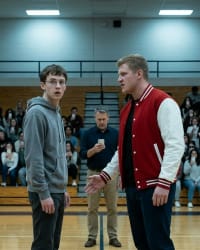
“Director Caldwell,” Garrett said quickly, his voice cracking slightly, “Noah came into the hallway looking for a fight because I beat him out for the starting spot.”
Dr. Evelyn Park stepped forward beside Director Caldwell and opened the manila folder in her hands.
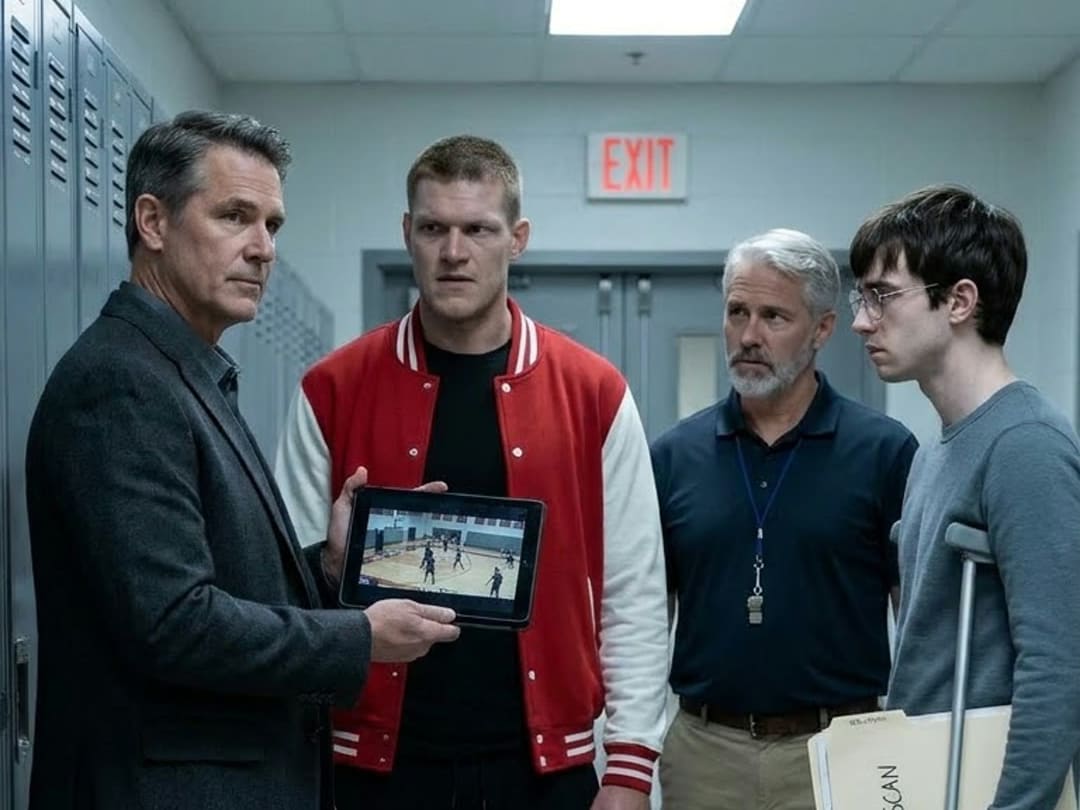
“That is an interesting theory, Mr. Cole,” Dr. Park said coolly.
“Because the reason I walked over from the sports medicine clinic twenty minutes ago was to hand-deliver Noah’s Orthopedic clearance report—and the biomechanical review of how his knee was injured in the first place.”
Coach Miller’s fingers twitched against the black lanyard around his neck.
“Dr. Park,” Coach Miller said quickly, “that tryout injury three weeks ago was a standard non-contact landing sprain during a fast-break drill.”
“That is what you wrote on the incident form, Coach Miller,” Dr. Park replied, holding up a single printed sheet signed in blue ink.
“You checked the box for a solo non-contact landing and signed your name certifying that no other player was involved.”
She turned the page in her folder and laid a high-resolution MRI scan sheet on top.
“However, when I examined Noah’s right knee this morning after the swelling fully subsided, the bruising pattern on the lateral tibial plateau did not match a flat hardwood landing.”
“It matched a severe lateral shear caused by Noah’s right foot coming down at an angle on top of an uneven object—specifically, another player’s shoe.”
The hallway went so quiet that you could hear the ventilation fans humming above the locker rows.
Dr. Park looked straight at Coach Miller.
“When I asked Noah this morning how the injury happened, he didn’t even try to get anyone in trouble,” she continued.
“He simply asked for his clearance signature so he could earn his spot back on the court.”
“So I walked over to Campus Security myself at ten o’clock this morning and requested the overhead camera feed from Court A on the afternoon of October sixth.”
Beside me, Garrett’s breathing turned shallow and rapid.
Coach Miller took half a step forward, raising one hand.
“Marcus, practice footage is internal coaching material,” Coach Miller said, a thread of desperation creeping into his voice.
“We don’t need to hold an inquiry in the middle of the locker-room hallway in front of the players.”
“You wanted to revoke Mr. Vance’s scholarship in the middle of the hallway in front of the players thirty seconds ago, Harlan,” Dean Whitaker said calmly.
“So I think everyone standing in this corridor deserves to see what was on that Court A camera.”
Looking back at those three weeks between the tryout injury and that Tuesday in the corridor, the hardest part had not been the physical pain in my right knee.
The hardest part had been limping into the film room every afternoon at three-thirty with my hinged brace locked
At thirty degrees while Garrett sat in the front leather chair spinning a basketball on his finger.
Every time the coaching staff broke down perimeter defense on the projector, Garrett would turn half around in his seat.
Glance down at my aluminum crutches leaning against the wall, and make a quiet remark loud enough for the first two rows to hear.
He called the aluminum shafts my “training wheels” and joked that the athletic department should charge me rent for taking up a locker stall I would never use in a real game.
Coach Miller heard every word from the podium at the front of the room.
Not once did he tell Garrett to face forward or show respect to an injured teammate.
Instead, Coach Miller assigned me to chart practice turnovers on a clipboard from the bottom row of the bleachers and collect the sweaty practice jerseys after scrimmage.
He wanted me to quit on my own before the November roster lock so he wouldn’t have to
Explain to the athletic department why the highest-scoring guard from the spring recruiting class wasn’t playing.
My uncle in Seattle had taught me something during my first year on the judo mat when I was nine years old and the smallest kid in the dojo.
He told me that a bully always tests your balance with small shoves first because he wants to know whether you will fall over before he commits his own weight.
If you argue, complain, or swing wildly when you are off-balance, you play his game on his terms.
You wait until your feet are healed, you let him step all the way across the line in the open.
And then you use his own forward momentum to put him on the mat.
So for twenty-one days I did every single isometric quad exercise Dr. Park prescribed at six in the morning before my eight o’clock chemistry lab.
I iced the joint four times a day in my dorm room, kept a straight face while charting turnovers from the bleachers.
And never once argued when Garrett kicked my gym bag out of the doorway.
By the third week, I could do single-leg squats on my right leg in the physical therapy room without a tremor.
Even though I still brought the crutches to campus until Dr. Park signed the final release.
That was why, when Garrett stepped in front of my hall locker on Tuesday afternoon with six cameras rolling behind him, I wasn’t afraid of his size or his father’s money.
He thought he was cornering a crippled freshman who needed two aluminum tubes just to stand upright.
He had no idea he was standing in front of someone who had been waiting three weeks for him to overcommit his weight in front of witnesses.
Director Caldwell lifted the black tablet in his hands and tapped the screen.
Director Caldwell turned the ten-inch tablet screen toward the semicircle of players and pressed play, setting the volume to maximum.
The timestamp in the upper corner of the video read October 6, 4:42 PM—the final five-on-five scrimmage of varsity tryouts.
On the screen, the scoreboard on the far wall of the practice gym showed the second unit leading Garrett’s first unit by four points.
Every player in the hallway leaned in as the recording showed me stealing a lazy cross-court pass from Garrett at the top of the key.
I pushed the dribble ahead down the right lane with Garrett trailing half a stride behind my right hip.
Director Caldwell tapped the pause icon right as I gathered the ball to go up for the layup, then switched the playback speed to quarter-time.
“Watch Mr. Cole’s eyes and his left foot,” Director Caldwell said quietly.
In slow motion, the high-definition ceiling camera showed Garrett wasn’t looking up at the basketball or the rim at all.
His eyes were locked straight down at my right sneaker.
As I rose into the air to lay the ball off the glass, Garrett lengthened his stride and slid his red-and-white high-top sneaker directly into my landing zone.
My right foot came down squarely on the inner edge of Garrett’s shoe, rolling my ankle inward and buckling my right knee at a brutal angle before I hit the hardwood.
One of the juniors standing in the hallway let out a low whistle of disgust.
“That’s a textbook undercut,” Brooks whispered, shaking his head as he looked at Garrett.
“You can end a guy’s whole career doing that under the rim.”
Director Caldwell didn’t stop the video there.
He let the recording run another fifteen seconds while I lay on the baseline clutching my right knee.
On the tablet screen, Coach Harlan Miller was standing at the free-throw line less than twelve feet away with an unobstructed view of Garrett’s foot.
The video clearly showed Garrett looking over at Coach Miller, and Coach Miller giving a sharp downward wave of his hand before blowing his whistle and calling the trainer.
Then the audio from the court-side directional microphone played clearly through the tablet speakers.
Everyone in the corridor heard my voice from three weeks ago asking from the floor, “Coach, did you see him slide his foot under me?”
And everyone heard Coach Miller’s recorded voice answer coldly, “You landed crooked on your own, Vance—don’t blame my captain because your legs aren’t ready for college ball.”
Director Caldwell tapped the screen to pause the frame and lowered the tablet to his side.
Nobody in the corridor spoke.
The six upperclassmen who had been laughing behind Garrett’s shoulder three minutes earlier took two full steps away from him, leaving Garrett standing completely alone by the lockers.
Garrett’s face was chalk-white against the crimson wool collar of his varsity letterman jacket.
“My foot slipped on a wet spot on the floor,” Garrett blurted out, his voice high and strained.
“I was trying to contest the layup and my sneaker slid forward by accident!”
“Save it for the conduct board, Mr. Cole,” Dean Whitaker said, pulling a small leather notebook from inside his suit jacket.
“Because we also have the two-minute hallway recording Mr. Brooks just filmed on his phone.”
Dean Whitaker motioned to Brooks, who stepped forward without hesitation and handed his white-cased smartphone to the dean.
Dean Whitaker watched the clip from beginning to end—the sneaker kick knocking my silver crutches across the terrazzo floor, Garrett’s jeer.
Coach Miller scrolling his phone by the doors, Garrett’s palm shove into my chest, and his lunge for my collar.
When the clip finished, Dean Whitaker handed the phone back to Brooks and looked at me.
“Mr. Vance,” Dean Whitaker said, “under university self-defense policy, you warned an aggressor after being shoved into a wall. Intercepted a second physical lunge, and used a single controlled trip when he swung his left arm at your head.”
“You released him immediately once he was on the floor and did not strike him.”
“There will be zero disciplinary action against your record or your scholarship.”
Then Dean Whitaker turned to Garrett, whose shoulders were slumped inside his oversized letterman jacket.
“Mr. Cole, you are placed on immediate athletic and campus probation pending a formal hearing on Friday morning for intentional reckless endangerment during tryouts and physical harassment in an athletic facility.”
“Until that hearing concludes, you are barred from the gymnasium, the locker room, and the weight room.”