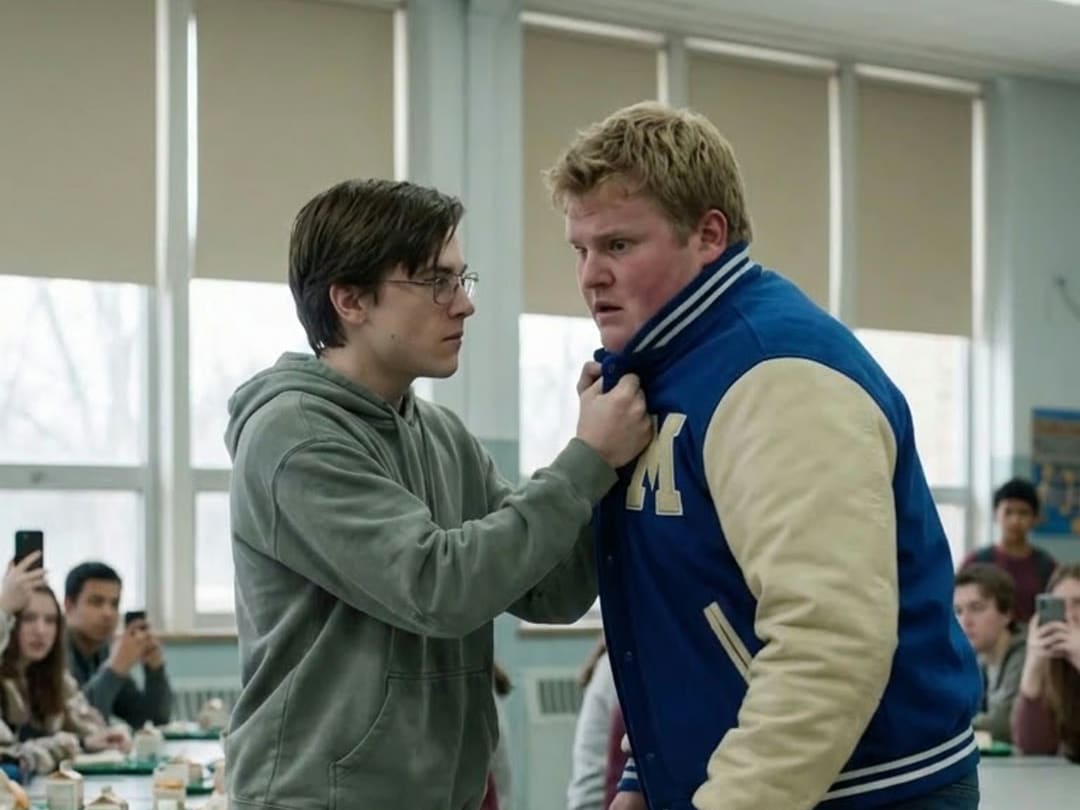
Chapter 1: The Blue Letterman Jacket
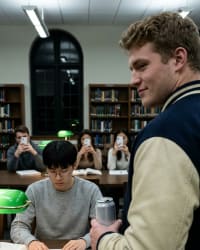
At the end of the cafeteria table, Jonah Reyes kept his lunch close.
His blue stool faced the wall of tall windows. Beige blinds softened the daylight, while fluorescent tubes cooled the room’s colors.
A green tray sat in front of him. He ate slowly, keeping his attention on the food.
The cafeteria carried on around him. Trays clattered, chairs scraped, and students called across the long tables.
Jonah had learned how to look occupied without needing to look busy.
He cut his food into small pieces. He drank from his carton. He kept his eyes near the tray.
His thin metal glasses slid down his nose when he leaned over. He pushed them back with two fingers.
The motion was familiar enough that he hardly noticed it. Most days, he could finish lunch without drawing attention.
At seventeen, he had become practiced at taking up little space.
His gray-green hoodie was faded at the cuffs. Khaki trousers showed a small crease where he bent his knees beneath the table.
His black sneakers rested flat on the cafeteria floor. He kept his elbows near his sides.
He knew Dalton Pryor, too.
Dalton was eighteen and the heaviest lineman at school. His size made him easy to notice before he said a word.
He was broad through the shoulders and chest. His sandy-blond hair was cut short, and his ruddy face looked redder beneath the cafeteria lights.
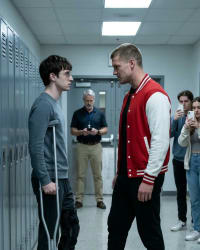
A royal-blue letterman jacket covered his white T-shirt. Cream leather sleeves and striped ribbing set it apart from the other clothes in the room.
One plain cream varsity letter marked the left side of the chest. Nothing else was printed there.
When Dalton walked between tables, people shifted to let him pass. The movement was small, but Jonah saw it.
Dalton stopped at the table where Jonah sat.
Jonah heard the stool legs scrape nearby. He kept his eyes on his tray.
The footsteps paused beside him.
Across the table, two students stopped talking. One set down a fork.
Jonah moved a piece of food around his plate. His hand remained steady.
He did not look up.
Dalton stood close enough to block the light from the windows. The shadow crossed Jonah’s tray first.
Then it covered his hands.
Jonah kept his gaze lowered.
The table seemed to get longer in the silence. At the next row, someone’s chair creaked.
A few conversations continued, thinner now. One student glanced toward the end of the table, then back at a phone.
Jonah knew the feeling of attention turning before he saw it. His shoulders tightened under the hoodie.
He still did not look up.
Dalton’s palm came down onto the crown of Jonah’s head.
The pressure pushed his head toward the tray. Jonah’s neck bent, and his glasses shifted against his nose.
The fingers spread across his hair. The hand held him there for a beat.
A student at the next table stopped chewing. Someone else turned fully toward them.
Jonah stayed still until Dalton lifted his palm.
His two fingers rose to the bridge of his thin glasses. He adjusted them once.
Then he looked up.
The cafeteria remained crowded, but the sounds had changed. Forks hovered above plates. A couple of students leaned to see.
Dalton stood over him, his blue jacket filling Jonah’s view.
Jonah’s eyes found Dalton’s face and stayed there.
“Keep your hands off.”
His voice came out quiet and low. It carried just far enough.
Dalton’s mouth tightened. His eyes stayed on Jonah.
Then he shoved Jonah in the chest with one flat hand.
Jonah slid backward off the blue stool. Its legs scraped across the floor and tipped beside him.
He landed sitting on the floor, one leg bent awkwardly, the other stretched toward the table.
The stool clattered down near his hip.
A breath went through the cafeteria. One student gasped.
No one stepped between them.
Jonah planted his palm on the floor. His glasses had shifted again, but they stayed on his face.
Dalton stood above him. The jacket’s cream sleeves caught the cool light.
A smile moved across Dalton’s face.
“I make the rules.”
The words settled over the tables. A few students lowered their eyes.
Jonah looked at the tipped stool, then at the hand he had braced against the floor.
He could feel the hard tile through his palm. His chest stung where Dalton had pushed him.
A strand of dark hair had fallen across his glasses. He brushed it away.
The tray remained on the table. His lunch sat where he had left it.
For a moment, he stayed beside the stool.
The people around him were no longer a blur of movement. He could see their faces turned toward him.
Some were watching without expression. Others held their phones low, near the table edge.
A few had lifted them.
Jonah drew his feet beneath him and stood.
The stool remained tipped behind him.
Dalton did not step back. His smile stayed in place.
Jonah moved close enough to reach the front of the letterman jacket.
He put both hands on it.
The wool and leather bunched beneath his fists. His fingers found the collar and the front panels.
Dalton’s body pitched forward a little. His smile disappeared.
Jonah held on.
“Your rules end today.”
He said it evenly. His jaw stayed set.
The crowd behind Dalton had gone quiet. Faces lined the tables and filled the space between them.
Dalton’s eyes widened. Then his expression hardened.
“You’ll regret that.”
Jonah did not let go.
The blue jacket pulled tight beneath his hands. A cream sleeve shifted as Dalton’s arms moved near his sides.
Jonah could feel the collar bunched against his knuckles.
His wrists stayed straight. He kept his feet planted on the cafeteria floor.
A phone was raised somewhere over Dalton’s shoulder. Another appeared beside a green tray.
The room held its breath around them.
Jonah had heard all four lines now. His first warning. Dalton’s answer. His own words. Dalton’s threat.
The crowd had heard them, too.
He could still feel the place on his chest where Dalton’s hand had struck. His shirt pulled against it when he breathed.
His glasses sat crooked on the bridge of his nose.
He did not look away from Dalton.
He had pictured answering Dalton before. He had pictured standing taller, saying something sharp, leaving the room before anyone could ask questions.
He had not pictured his fists on Dalton’s collar.
The choice had come quickly. His hands had moved before he had time to sort out what came next.
Now the seconds stretched.
Dalton’s weight leaned toward him. Jonah could feel the pull through the jacket.
A chair creaked behind them. No one called out.
Jonah thought of the youth club mat.
He had started wrestling when he was nine. The mats had smelled of rubber and detergent, and the room had been cooler than the cafeteria.
His coach corrected how he placed his hands. He taught him to keep his weight balanced and to watch where his partner moved.
A grip, the coach said, was for control. It was not for showing off.
The jacket pulled against his hands again. Dalton shifted his weight.
Jonah could have held tighter. He could have drawn Dalton closer or tried to make the room watch something worse.
He could have turned the moment into the kind of scene people might repeat for days.
The choice was not about whether Dalton had crossed a line. His palm had pressed Jonah’s head down. His shove had sent Jonah from the stool.
Jonah had said what he needed to say. He had put his hands on the jacket.
Now he had to choose what those hands would do.
The cafeteria remained silent. The tables, trays, and stools seemed fixed in place.
Jonah’s fingertips pressed into the cloth. He felt the thick seam beneath his thumb.
Dalton stared at him. His mouth had gone flat.
Jonah took a slow breath.
His shoulders lowered by a fraction. His hands opened.
The jacket relaxed beneath his fingers.
He let go.
Dalton rocked backward, as if he had expected Jonah to swing.
Jonah did not.
He stepped aside and gave Dalton room to stand straight.
The space between them widened. Jonah’s hands fell to his sides.
One remained slightly curled from holding the collar. The other rested open beside his thigh.
Dalton looked down at the jacket, then back at Jonah.
His arms hovered near his body. He did not reach for Jonah.
The stool stayed tipped on the floor.
Around them, the students watched. Some remained bent over their tables, shoulders angled toward the two boys.
Others had turned fully around on their stools. Several phones were raised above the crowded tables.
Jonah stood beside the stool he had fallen from.
Dalton stood in front of him, no longer holding the jacket taut.
Neither boy moved.
The room had seen Jonah pushed down and shoved from his seat. It had seen him rise, take Dalton’s collar, and then release it.
Now the phones pointed at both of them.
Jonah could not tell what any recording showed. He could not see which students had been filming before the shove or when they had started.
He knew what he had done. He knew what Dalton had done.
The crowd had witnessed both.
Jonah looked at the open space between them. He had made it himself.
Dalton had expected a swing. The waiting students had expected something, too.
What they got was Jonah stepping away.
The cafeteria stayed quiet, and neither boy could leave that moment unseen.
Dalton rocked back when Jonah’s hands opened.
His jacket collar slipped free, the fabric settling against his chest.
Jonah stepped aside, leaving room between them.
A chair creaked near the end of the table.
Then another creaked as someone leaned closer.
The cafeteria fell quiet enough for Jonah to hear his breathing.
Dalton looked down at the collar, then at Jonah.
His hands hovered near his wrists, but they never reached.
Jonah kept his own hands at his sides.
The tipped blue stool lay beside him.
One leg pointed toward the long table.
A green tray rested on the floor nearby.
A fork had slid beneath it, its handle catching the light.
Jonah noticed each thing without moving to pick it up.
His pulse thudded in his neck.
He could still feel the jacket bunched beneath his fingers.
He could still hear his own words in the room.
The silence gave them nowhere to hide.
Dalton shifted his weight.
His shoulders stayed high inside the blue-and-cream jacket.
He looked ready for Jonah to do something.
Jonah did not.
He took another half step back.
That small movement widened the space between them.
A student’s phone remained raised over the table.
Another screen glinted near the windows.
Jonah could not tell which students had started recording.
He could not tell what any phone had captured.
The room held its breath around him.
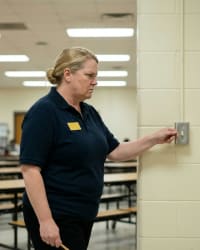
The lunch supervisor came quickly from the serving area.
Her shoes made short, hurried steps across the tile.
She looked from the stool to Dalton, then to Jonah.
“What happened here?”
A dozen voices answered at once.
“He shoved him.”
“He pushed his head down.”
“Jonah grabbed his jacket.”
“Dalton started it.”
“He fell off the stool.”
The replies overlapped until none could be followed.
The supervisor raised one hand.
The students fell silent again.
She looked at Jonah first.
“Are you hurt?”
Jonah glanced at his palms and flexed his fingers.
“No,” he said.
His voice sounded quieter than it had during the warning.
He looked at the tipped stool.
“I landed beside it.”
The supervisor nodded, then looked at Dalton.
“Did you push him?”
Dalton’s jaw shifted.
He glanced at the watching tables.
For a second, he seemed to search their faces.
Then he gave a short laugh.
It was too loud for the silence.
“Come on,” he said. “It was nothing.”
Nobody joined him.
The laugh ended by itself.
A student lowered a phone an inch, then raised it again.
Dalton looked toward the supervisor.
She did not answer his laugh.
Instead, she crouched beside the stool.
She checked its legs and looked at the tray on the floor.
Then she studied Dalton’s hands.
His fingers were open now, close to his sides.
She looked back at Jonah.
“Can you tell me what happened?”
Jonah swallowed.
He had learned to keep his answers short.
Short answers gave people less to carry away.
Short answers also left room for someone else’s version.
He looked at the phones across the tables.
He looked at Dalton.
Then he looked at the supervisor.
“He pressed my head down with his palm,” Jonah said.
The words came out evenly.
“Then he shoved me off the stool.”
The supervisor listened without interrupting.
“After that, he said he made the rules.”
Jonah paused.
“I stood up and grabbed his jacket.”
He opened and closed his right hand once.
“I told him his rules ended today.”
The room stayed still.
“He said I’d regret it,” Jonah continued.
“I let go. I didn’t hit him.”
The supervisor nodded once.
Jonah felt the attention around him settle differently.
He had not described himself as helpless.
He had not hidden the part that made his hands look dangerous.
He had put both parts in the same account.