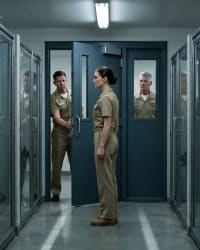
The next morning, I went back to the barracks.
The windows were clouded with breath.
Someone had left a towel over the radiator.
A damp corner lifted and fell in the heater’s weak current.
My bunk was still made.
The notebook’s place under the pillow was empty.
I stood beside the mattress.
My hands went to the blanket, then stopped.
The pillow kept its shallow dent.
Eli’s bunk was two beds down.
His glasses were gone from the small shelf above it.
A folded paper sat beside his empty water cup.
I didn’t touch it.
A recruit I didn’t know was folding a clean shirt.
He looked up when I turned.
“Park’s with the medics,” he said.
“He asked where you were.”
I nodded.
The recruit went back to his shirt.
I sat on my bunk.
The mattress creaked beneath me.
The room had always seemed full of noise.
Now I could hear the heater knock inside the wall.
Once.
Then twice.
My hands began to shake.
I pressed them flat against my thighs.
The fabric of my trousers was rough under my palms.
A minute passed.
Then I stood and went to the washroom.
The mirror was spotted with water.
My hair had dried in uneven strands.
A strip of fluorescent light cut across the glass.
I looked at the place where the mark sat beneath my shirt.
The compass star was hidden again.
I pressed two fingers against the cloth.
The stitches touched my skin.
For weeks, that little mark had been an answer I kept to myself.
Now it felt like a question.
A knock sounded at the open doorway.
Eli stood there with one crutch under his arm.
His ankle was wrapped.
He had his glasses on.
“You should be sitting,” I said.
“I am standing.”
His mouth twitched.
Then he took a careful step inside.
I moved the chair closer.
He lowered himself onto it, one hand gripping the seat.
The crutch slid against the wall.
I caught it before it hit the floor.
“Thanks,” he said.
His voice was steady.
I set the crutch beside him.
His glasses were crooked again.
“You saw Brandt give him the bottle.”
Eli nodded.
“I saw him at the cooler.”
The memory seemed to settle behind his eyes.
He rubbed one thumb along the chair arm.
“Why didn’t you say something earlier?”
His eyes went to the floor.
His thumb rubbed the crutch handle.
“I thought he’d say I was making it up.”
He swallowed.
“I thought he’d take my place in the course.”
“I thought everyone would believe him.”
I pulled a chair over.
It scraped against the floor.
“You didn’t have to stand up in that hall.”
He looked toward the door.
The empty doorway held his gaze.
“I kept thinking about the bread.”
“Half of it.”
He gave a small nod.
“I thought maybe I could do one thing back.”
My palms rested on my knees.
The skin there was red from the rough fabric.
“You did.”
He looked at me then.
His eyes moved from my face to the mark hidden under my shirt.
“I didn’t know who you were,” he said.
“No.”
“I still would’ve said it.”
I let his words sit between us.
He kept both hands on the chair.
His shoulders were lifted near his ears.
“You were afraid,” I said.
“I was.”
His shoulders rose.
Then fell.
“I’m still afraid,” he said.
“But I said it.”
The hallway outside carried voices and footsteps.
Eli looked toward the sound.
A pair of recruits passed the open door without stopping.
Their voices faded down the corridor.
I left the chair in place.
I didn’t tell him he was brave.
He had already done the hard part.
He didn’t need me to name it.
Eli reached for the crutch.
I held it steady while he set the grip under his palm.
He leaned forward and stood.
The chair legs scraped backward.
“See you around?” he asked.
“Yes.”
He nodded.
His glasses slipped again.
This time he caught them before they fell.
The hearing came eleven days later.
I wore my uniform and sat with my hands folded in my lap.
The room had a narrow table and a wall clock.
Its second hand moved without a sound.
Brandt sat across from me.
A glass of water stood near his right hand.
He had placed it exactly on a paper coaster.
The notebook was on the table.
Its black cover looked smaller in the bright room.
The entries listed dates and what I had seen.
Hayes read the dates aloud.
He turned each page carefully.
The paper made a dry whisper.
Eli gave his statement.
Six recruits gave theirs.
Cole’s statement was included.
He named Brandt’s words about the bottle and the phrase, “Let’s see her break.”
Brandt looked at the table.
His fingers rested beside the glass.
The water inside trembled slightly when his knee moved.
The room went quiet.
I could hear the clock.
When the decision came, Brandt was relieved and separated.
Landry was dropped from the program.
No one raised a voice.
The notebook remained on the table.
The glass of water stayed untouched.
I looked at Brandt’s hands.
His fingers had curled into the edge of the paper coaster.
Outside, Brandt stopped beside me.
His hands hung at his sides.
“You were good,” he said.
“I looked right at you, and never saw it.”
“That was the point.”
He gave one small nod.
Then he continued down the hall.
The fabric at his back shifted with each step.
I watched his shoulders until he turned the corner.
Then I let out the breath I had been holding.
The air left slowly.
My fingers opened against my uniform trousers.
I went home on a Thursday.
My key stuck in the lock, as it always did.
The metal scraped against the frame.
I turned it once, pulled it back, and tried again.
The porch light was on.
A stack of mail waited on the kitchen table.
I stood inside the doorway.
My boots dripped onto the mat.
The house smelled like dust and cold tea.
I put the kettle on.
The switch clicked down.
While it warmed, I took off my uniform shirt.
The mark stayed hidden beneath the folded cloth.
I hung the shirt over the back of a chair.
The olive thread disappeared against the shadow of the fabric.
I sat at the table.
The kettle clicked off.
For a while, I only listened.
No boots, no whistle, no names called across the room.
The refrigerator hummed.
A car passed outside, tires hissing on the wet road.
I poured hot water into a mug.
The steam warmed my face.
I held both hands around the mug until its heat reached my palms.
I slept eleven hours that night.
When I woke, gray light rested on the window.
I stayed in bed until my body stopped bracing for a command.
Then I stood and opened the curtains.
The rings slid along the rod with a soft rattle.
Weeks passed.
I returned to teaching at another site.
My new class had no idea who I was.
The training room had bright windows and scuffed wooden floors.
A row of recruits waited beside the equipment rack.
I let them see the mark when the lesson called for it.
On other days, I wore a plain shirt.
No one asked about the stitches.
When I explained the course, I showed them the compass first.
I let them set their own bearings.
A recruit once tried to rush through the instruction.
I stopped him and asked him to check his partner’s map.
He bent back over the paper.
The corner shook beneath his fingers.
I waited until he finished.
I kept the notebook in a desk drawer.
Some mornings I took it out and read the dates.
I didn’t need to read every line.
I knew what the pages held.
The paper had begun to soften at the edges.
The ink stayed dark.
The cold mornings came.
My hands shook less often.
When they did, I set them flat on the table and waited.
I no longer tried to hide the movement.
In December, a padded envelope appeared by my door.
It had no return address.
The envelope rested against the welcome mat.
The paper was creased along one corner.
Inside was a pair of glasses.
A strip of tape crossed the bridge.
The lenses were scratched.
One arm sat crooked.
A note was folded around them.
The writing was careful and blocky.
Instructor Hale.
I passed.
I have new ones now.
These are the ones I had when you carried me.
You said nobody was counting.
I counted.
Thank you for letting me be one of the ones who made it.
Eli.
I sat on the kitchen floor.
The glasses rested across both palms.
The tape had yellowed.
My thumb stopped just short of the scratched lens.
I laughed once.
Then I cried.
I didn’t know which sound had come first.
I held the glasses until my hands stopped shaking.
After a while, I stood.
I carried them to the windowsill.
Morning light reached the lenses.
It caught the tape and turned it gold.
I left them there.
They’re still there.
Sometimes I think of the water in the training hall.
I remember the bottle turning in Cole’s hand.
I remember Eli’s fingers locked around the chair.
I remember Hayes’s boots crossing the mat.
I remember Brandt looking toward the clock.
I remember the way no one moved until someone spoke.
Those memories don’t make the house feel smaller now.
They don’t fill every quiet space.
I can drink water without remembering the hall.
I can hear rain on the roof and sleep through it.
I can sit at my kitchen table without counting who’s missing.
I can let the kettle finish before I stand up.
That is what peace looks like for me.
Not forgetting what happened.
It is being able to set the notebook aside.
It is letting the morning arrive without preparing for it.
The glasses catch the light beside the window.
The small strip of tape stays where Eli put it.
I think about how often people decide the quiet one can take more.
How often a room waits for someone else to speak first.
I know what silence can protect.
I know what it can cost.
Cole lost his place in the program.
Brandt was relieved and separated.
Eli spoke when his hands were shaking.
I wrote down what I saw, and I came home.
I can’t make the cost equal.
I can only say what happened.
The mark is still sewn into my shirt.
It doesn’t make me stronger than the people who never saw it.
It reminds me that a person is more than the story others tell about them.
It reminds me to look twice.
When someone is mocked, I look at who watches.
When someone is hurt, I listen for who answers.
I don’t ask whether the person can take it.
I ask who should have stopped it.
That question stays with me.
It no longer keeps me awake.
The porch light turns on at dusk.
The glasses wait in the window.
I make tea.
I sit down.
And if you had been there, whose side would you have taken: Cole’s, or the sergeant’s?