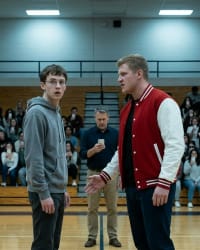
At 4:52 a.m., the campus was still dark, and the sprinklers were hissing across the quad.
Mateo walked to the dining hall the way he did every morning, past the library and the locked coffee cart.

His phone had buzzed all night. He had turned it face down on his desk and slept maybe two hours.
The kitchen’s back door was propped open with a milk crate, like always.
Martha Gomez stood at the scullery sink, tucking her gray hair into a hairnet. She looked at Mateo over her glasses.
“You came in.”
“It’s five o’clock,” Mateo said. “I work at five.”
She handed him a rubber apron and pointed at the dish machine with her chin.
The scullery is the loudest room on campus. Trays slam, steam hisses, and the conveyor belt rattles like a freight train.
That morning, Mateo loved every bit of it.
Nobody in that room cared whose father had paid for anything.
Mateo scraped dried oatmeal off the first rack and pushed it into the machine. The hot water stung his wrists.
Six hours earlier, a lawyer had slid fifty thousand dollars and a gold pen across a boardroom table at Mateo.
He had never touched the pen. This sink paid a lot less, but every dollar was clean.
At 5:20, the back door banged open.
Two hurdlers and a distance runner from Mateo’s team stood in the doorway, still wearing their warm-up jackets.
These were guys who had barely nodded at him all season.
They were also the guys Hutchins had kept in his 5:15 meetings while he marked Mateo absent.
“Where do you want us?” the tallest one asked.
Mateo stood there holding a dripping tray.
Martha tossed them three aprons before he could answer.
By six, the night crew had stayed past their shift. Then students started drifting in, some still in pajama pants.
They scrubbed pots. They stacked cups. They carried bus tubs from the loading dock without being asked.
Nobody asked Mateo about the microphone. They just worked next to him.
Around six-thirty, one of the hurdlers dried his hands and held his phone in front of Mateo’s face.
The stadium video had a tag now: #PodiumMic.
It had passed ten million views overnight.
He scrolled for Mateo. Former Olympic sprinters had shared it. High school coaches from Texas to Maine had posted it.
A sports talk host had called it “the ugliest thing money ever bought at a track meet.”
Thousands of comments said the same thing in different words. Get the boosters off the infield.
Mateo handed the phone back and picked up the next tray.
At 7:40, Mateo’s own phone buzzed against the steel counter. It was a text from Athletic Director Marcus Vance.
Main auditorium. 8:30. Wear the grey shirt.
Martha read it over his shoulder. She took the sprayer out of his hand.
“Go,” she said. “I’ve got forty helpers this morning.”
The Spring Athletics Assembly happens every year in the main auditorium. Usually it’s half empty, mostly parents and a few coaches.
That morning, Mateo stood behind the stage curtain and peeked out.
Every seat was full. People stood along the back wall and sat on the steps of the aisles.
Hundreds of them wore heather-grey t-shirts, the same plain running shirt Mateo had worn on the podium.
The first three rows held older men and women in blazers. Some wore faded team pins on their lapels.
Vance stood beside him, reading a folded sheet of paper.
“Track alumni,” he said quietly. “Some of them flew in at midnight.”
At 8:34, the side doors opened.
Harrison Whitman walked in wearing a charcoal suit that probably cost more than Mateo’s tuition. Chase followed in navy, his blond hair slicked back.
Their attorney, Richard Cole, came last with a leather folder under his arm.
Mateo could guess what was in that folder. Whitman had promised to serve the eviction notice at nine.
Whitman checked his gold watch and smiled toward the stage.
Then he looked at the crowd.
His step shortened. He walked the rest of the way to his reserved seat more slowly.
Chase kept his eyes on the carpet.
At 8:40, Vance and Dean Aris Thorne walked out to the podium. The room went quiet.
Cameras from three regional sports stations stood on tripods at the back. Flashbulbs popped.
“Good morning,” Vance said. “I’ll start with some business.”
“At eight o’clock this morning, I delivered the infield tunnel footage to the county prosecutor.”
A low murmur rolled through the seats.
Whitman crossed his legs and studied his fingernails.
“Last night, Mr. Whitman reminded us that his family trust owns the land under our track,” Vance went on.
“He told us we’d be evicted at nine o’clock today.”
He paused and looked straight at the reserved row.
“He was right about the land. He owned it.”
Whitman’s foot stopped bouncing.
Vance held up a thick stack of paper bound with a black clip.
“This is the 1984 lease. Section nine gives the university the right to buy that land at appraised value, any time, with cash in hand.”
“We read it at two o’clock this morning.”
Vance turned toward the front row and nodded at a lean, silver-haired man in a grey t-shirt.
“Raymond Ellis ran the 400 for this school. He won three Olympic medals.”
“Last night, he made forty-one phone calls to former teammates and local business owners.”
“At 8:12 this morning, the money cleared. At 8:31, the deed was recorded with the county.”
“The track belongs to this university now. The Whitman lease is finished.”
The room exploded. People stood on their seats.
Down in the reserved row, Richard Cole flipped through his leather folder. He stopped on a page, read it twice, and closed the folder.
Whitman leaned toward him and whispered something sharp.
Cole shook his head once and looked away.
Vance raised a hand until the noise settled.
“The syndicate raised more than the land cost. The rest becomes an endowed scholarship for athletes who work their way through school.”
“We’re calling it the Five A.M. Fund.”
At the back of the auditorium, Mateo saw Martha standing by the doors. She still had her hairnet on.
Vance looked down at the reserved row again.
“Mr. Whitman has also promised to pull his family’s fourteen-million-dollar endowment. He’s welcome to.”
“Nobody’s scholarship in this building is for sale.”
Whitman’s hand closed hard around the armrest.
Then Dean Thorne stepped up to the microphone.
“Last night, campus police confiscated Dale Hutchins’s team clipboard,” he said.
“Our chief timing steward, Tom Miller, compared it overnight against the electronic timing system.”
He let that settle.
“Chase Whitman’s preliminary times this season were written in by hand. Every one of them was faster than the timing system recorded.”
Chase’s head came up for the first time.
“Effective immediately, his season qualifying marks are vacated. His conference silver medal is revoked.”
The flashbulbs went off in a long, rattling wave.
A conference official in a blue blazer walked down the aisle to the reserved row. He stopped in front of Chase and held out his open palm.
Chase reached into the inside pocket of his suit.
He placed the silver medal in the official’s hand without a word.
Whitman stared straight ahead at the stage.
“One more thing,” Vance said. “This morning I’m presenting a resolution to the Board of Regents.”
“It removes the Whitman family name from the stadium gates.”
The applause hit like a wall of sound.
Then Vance turned toward the curtain.
“Mateo Reyes, would you come out here?”
Mateo’s legs felt the way they had at the 300-meter mark. He walked out anyway.
The lights were hot on his face. The grey shirts in the seats blurred together.
Vance lifted a heavy silver trophy from a table beside the podium. The Conference 400-Meter Championship.
He placed it in Mateo’s arms. The metal was cold against his wrists, still pink from the dish water.
“Mateo has earned a guaranteed four-year full scholarship, athletic and academic,” Vance said.
“And starting next season, he is captain of the varsity track team.”
The whole auditorium stood up.
It went on so long Mateo lost track of time. He just held the trophy and looked at the back doors.
Martha had both hands over her mouth.
Vance tipped the microphone toward him. Mateo leaned in close.
He checked the little switch on the handle first. The crowd laughed.
“Thank you,” Mateo said. “I have a dish shift at five tomorrow. Everybody’s welcome.”
The roar came back even louder.
Down in the reserved row, Harrison Whitman stood and buttoned his jacket. Chase got up behind him.
The aisle was packed with students in grey shirts, all on their feet and clapping.
Nobody moved aside.
Whitman had to turn sideways and push his way through, one shoulder at a time. Chase followed with his head down.
Richard Cole trailed them, holding his leather folder against his chest.
At the doors, Whitman glanced at his watch.
It was 9:02. His deadline had passed, and nobody in the room was looking at him.
The doors swung shut behind them.
The next evening, Mateo walked out onto the empty track at dusk.
The floodlights were just warming up, buzzing faintly on their towers. The sky over the bleachers had turned deep blue.
Someone had hung a canvas tarp over the name on the stadium gates.
The red rubber was still warm from the afternoon sun. He could feel it through his worn white running shoes.
Mateo walked to the starting line of lane eight and stretched slowly. Calves first, then hamstrings, then his shoulders.
The painted white eight at his feet was scuffed from a hundred practice starts nobody had ever bothered to film.
Next week, the conference plaque inside the fieldhouse lobby would carry his name beside that lane number in engraved brass.
The podium stood alone on the infield grass. The microphone stand was gone.
Mateo took a deep breath. The air smelled like cut grass and rubber.
Then he started running.
There was no clock and no crowd. Nobody waiting at the finish to take anything from him.
His stride felt longer than it had in months. His arms swung loose and easy.
As Mateo came around the final curve, he heard footsteps on the track behind him.
The two hurdlers and the distance runner from the scullery had jogged out from the tunnel.
They fell in beside him without a word, matching his pace.
The four of them ran down the home stretch together, straight into the floodlights.
Who was more out of touch—the coach who thought a microphone was turned off, or the booster who thought a college ran entirely on his wallet?