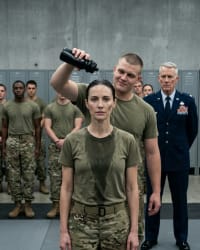
Paramedics wheeled Midshipman Julian Vance toward the academy medical clinic on a gurney.
The young plebe offered Loretta a quiet nod through his clear oxygen mask.

Loretta dried her wet forearms with a fresh cotton towel from the locker bin.
Beside her, Chief Miller locked the natatorium glass doors to preserve the scene.
Miller held up evidence bags containing the severed line, utility knife, and weighted vest.
“The pool pump logs and midshipmen videos are secured on encrypted drives,” Miller said.
Admiral Whitlock motioned toward the administration building, inviting Loretta inside.
“Follow me to my office, Master Chief,” Whitlock said quietly.
They walked together down the limestone corridor toward the Superintendent’s corner office.
Inside, tall mahogany shelves and polished brass lamps caught the gray afternoon light.
Before Whitlock reached his desk, the secure red telephone console began buzzing sharply.
Whitlock pressed the speakerphone toggle with a firm, steady thumb.
“Graham, this is Harlan Brandt,” a gravelly voice snapped across the room.
The caller was a retired rear admiral and influential academy foundation trustee.
“I just spoke with Cody’s civilian defense attorney,” the retired officer barked.
“You have my son sitting in handcuffs at the provost marshal station.”
Whitlock kept his shoulders back, his expression carved from gray granite.
“Your son committed aggravated assault and near-fatal reckless endangerment,” Whitlock answered.
“That is ridiculous grandstanding,” the retired admiral replied in a cold sneer.
“He was running a standard qualification drill to restore unit discipline.”
“An unregistered custodian assaulted a commissioned officer and disrupted class curriculum,” Brandt stated.
“My foundation legal team is preparing an emergency federal injunction right now.”
“Drop these absurd charges, Graham, or we will pull twenty million in foundation funding.”
Whitlock leaned forward over the desk, resting his knuckles on the dark blotter.
“Your son nearly drowned a plebe out of pure vindictive malice,” Whitlock replied.
“He froze on the coping while an actual rescue swimmer saved the boy.”
“She is an hourly janitor who empties trash cans across campus,” Brandt scoffed.
Whitlock glanced at Loretta, who stood calm and still beside the window.
“She is a Master Chief who dragged me from a sinking cockpit,” Whitlock said.
“Her mission was classified, Graham, which means it legally never happened,” Brandt retorted.
“You cannot cite sealed operations in a court-martial specification.”
“Watch me,” Whitlock said, and snapped the disconnect switch.
Whitlock swiped his gold flag-officer credential through the encrypted desktop terminal.
“I am opening an emergency flash channel directly to the Pentagon,” Whitlock said.
He submitted an expedited petition to unseal the October 24, 2004 rescue logs.
Loretta looked down at her weathered hands resting against her faded grey coveralls.
“I never looked for medals or public praise, Admiral,” she said softly.
“I only did the job I was trained to do.”
Whitlock shook his head, his eyes bright with deep conviction.
“You pulled me out of a coffin forty feet under the Atlantic, Loretta.”
“You will not spend another day hiding in the shadows of this academy.”
Whitlock tapped the wall intercom to summon the base quartermaster.
“Chief Warrant Officer Ramos, report to my office with a female Master Chief uniform.”
Within fifteen minutes, a quartermaster arrived bearing an immaculate service dress blue uniform.
The dark wool jacket displayed the embroidered gold fouled anchors of a Master Chief.
Loretta ran her calloused fingers over the crisp fabric and gold rating badges.
A sharp electronic chime echoed from the secure teletype printer in the corner.
A formal dispatch bearing red Pentagon priority classification stamps fed onto the tray.
The verified declassification order lifted every legal redaction from the October 2004 mission.
Attached were the original squadron teleprints from the aircraft carrier rescue detachment.
They documented forty-foot swells, blinding freezing rain, and a capsized SH-60 Seahawk.
The logs described how Ames plunged into the black surf without hesitation.
She dove repeatedly into the sinking cockpit as the fuselage tilted toward the abyss.
She supported the unconscious pilot in the freezing swells until the hoist cable arrived.
“The original combat valor citation is officially restored to active records,” Whitlock said.
He slid the verified dispatch into a dark leather command presentation binder.
Whitlock checked the brass wall clock, which showed 1640 hours.
“Chief Miller, sound the call for an all-hands brigade assembly in the Great Hall.”
By 1700 hours, the Great Hall of Midshipmen was filled to capacity.
Five hundred midshipmen sat in rigid, silent formation across the polished hardwood floor.
Academy faculty officers and senior enlisted instructors lined the raised side galleries.
In the front row, the water-survival qualification squad sat in crisp summer whites.
Midshipman Julian Vance sat among them, a neat white dressing taped across his forehead.
The massive oak side doors swung open, drawing every gaze in the room.
Lieutenant Cody Brandt entered the hall alongside a tall civilian lawyer in gray pinstripes.
Brandt wore a clean khaki uniform, but his collar points remained bare and stripped.
His face held a smug, confident smirk as he whispered to his counsel.
Brandt assumed his father’s foundation leverage had already squashed the disciplinary inquiry.
He cast a derisive, superior glance toward the plebes seated in the front row.
Brandt took his seat at the administrative table positioned before the wooden rostrum.
“This entire proceeding is an unauthorized administrative farce,” the civilian lawyer muttered.
Brandt smiled faintly, confident that backroom political pressure would shield his career.
Chief Miller and Patrol Officer Torres stepped onto the dais at rigid parade rest.
Behind them walked Vice Admiral Graham Whitlock, resplendent in service dress whites.
The entire hall snapped to attention in a thunderous crack of polished shoes.
Whitlock mounted the wooden rostrum with slow, measured authority.
Whitlock laid the dark leather binder flat upon the brass lectern.
“Brigade, be seated,” Whitlock commanded into the public address microphone.
The sudden shuffle of five hundred chairs subsided into complete, breathless silence.
Whitlock gripped both edges of the wooden lectern, leaning toward the silent brigade.
“This academy exists to forge naval officers of unyielding character and courage,” he began.
“This morning, an instructor mistook quiet service for weakness on my pool deck.”
Brandt’s smirk flickered, his fingers tightening against the arms of his wooden chair.
“His family believed a twenty-million-dollar foundation threat could buy silence here today,” Whitlock said.
“At noon, I told the foundation board in writing to keep every dollar of it.”
Whitlock turned his eyes directly toward Brandt, his voice dropping to cold steel.
“No checkbook in this country outranks the lives of the midshipmen in these seats.”
A sharp, collective intake of breath swept through the rows of seated midshipmen.
“When high-suction intake pinned a plebe on the bottom today, rank did not save him.”
Whitlock gestured toward the front row where Julian Vance sat with his head high.
“A retired senior enlisted sailor went fifteen feet down bare-handed to bring him back.”
Brandt started to push himself up from his chair, but his lawyer gripped his wrist.
“You all knew her as the custodian, because the Navy sealed her name for twenty years.”
Whitlock opened the presentation binder and extracted the red-stamped Pentagon teleprints.
“For twenty years, her valor was locked in a sealed vault under military secrecy.”
Whitlock raised the official declassified document before the gathered assembly.
“On October 24, 2004, an SH-60 Seahawk ditched into forty-foot Atlantic gale seas,” Whitlock read.
“Master Chief Loretta Ames leapt into the freezing dark to reach a sinking cockpit.”
The plebes leaned forward in their chairs, their eyes wide with reverent shock.
“She cut through tangled steel cables and kept an unconscious pilot alive until recovery.”
Whitlock looked up from the teleprint and looked across the sea of midshipmen.
“That dying pilot was a young lieutenant named Graham Whitlock,” he said quietly.
A stunned, audible gasp echoed across five hundred midshipmen and faculty.
Brandt turned stark white, the blood draining completely from his jaw and cheeks.
“Master Chief Ames, take the stage,” Whitlock commanded into the stillness.
Loretta Ames marched onto the dais in her pristine Master Chief service dress blues.
The gold anchor collar insignias and combat ribbons shone under the overhead spotlights.
Inside her breast pocket rested the heavy brass coin, secured on a fresh black cord.
She halted three paces from the lectern and rendered a sharp, textbook salute.
Whitlock returned the salute with crisp, formal perfection.
“By direction of the Secretary of the Navy, your citations are restored,” Whitlock announced.
He lifted a dark velvet case containing the Navy Commendation with Combat Valor.
Whitlock pinned the gleaming medal over her left breast pocket with steady fingers.
“For extraordinary heroism and selfless devotion to the United States Navy,” Whitlock declared.
“Effective today, our survival facility is renamed the Loretta Ames Water Survival Center.”
Midshipman Julian Vance jumped to his feet, clapping his hands together with fierce pride.
The entire plebe squad rose instantly behind him, cheering with raw, unbridled emotion.
Within moments, all five hundred midshipmen and officers stood in a thunderous standing ovation.
Loretta stood at attention on the raised platform, her eyes clear and unwavering.
Whitlock raised a single hand, bringing the roaring auditorium back to rigid silence.
Brandt remained frozen in his chair, his hands trembling violently on the wood.
His civilian lawyer stared down at his legal pad, entirely silent and motionless.
“Lieutenant Cody Brandt, stand,” Whitlock commanded in a low, merciless tone.
Brandt dragged himself upright on shaky knees, clutching the edge of the desk.
“You have violated Articles 90, 92, 128, and 133 of the Uniform Code,” Whitlock said.
“You are charged with insubordination, dereliction of duty, aggravated assault, and conduct unbecoming.”
The civilian attorney slowly closed his leather briefcase and made no move to speak.
“No family influence or foundation board connection will shield you from federal justice,” Whitlock added.
“I have signed the charge sheet referring all four specifications to a general court-martial,” Whitlock announced.
“Chief Miller, Patrol Officer Torres, remand the accused to the naval brig to await trial.”
Chief Miller stepped forward and took Brandt firmly by the upper arm.
Brandt stumbled as the two armed security officers turned him toward the exit.
He kept his head buried against his chest, unable to meet any midshipman’s gaze.
Five hundred cadets watched in cold, unwavering silence as Brandt was marched out.
The heavy oak doors of the Great Hall closed behind him with an echoing thud.
Night settled over the Brightwater Naval Academy, bringing a cold breeze off the bay.
Inside the empty natatorium, amber maintenance lights cast long, warm reflections across the water.
The blue surface was glass-smooth, lapping softly against the chrome drain gutters.
Loretta walked alone along the wide white tile deck beside the 15-foot diving well.
Near the entrance, a fresh bronze wall plaque gleamed in the amber light.
It bore her name and Master Chief rank in deep, permanent lettering.
Loretta stopped beside the chrome pool ladder where she had been shoved that morning.
She reached into her pocket and drew out the heavy brass coin in her palm.
Her weathered thumb traced the raised relief of the Seahawk helicopter over the anchor.
For twenty years, she had carried the memory in silence while sweeping wet tile floors.
Now, her true service was carried in the open light of day.
Who showed true naval strength today—the officer who hid behind his rank, or the custodian who let her courage speak for itself?