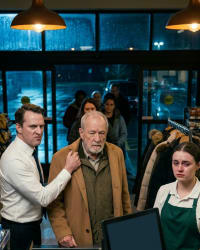
The lobby had gone quiet.
It is a strange thing, a lobby gone quiet.
There was still music playing from somewhere, a soft piano.
There was still rain on the glass.
But every person in the room had turned to see what a person in a cheap jacket had done.
A woman in a green coat lifted a phone and then, seeing Gideon’s face, lowered it again.
A bellman looked at his shoes.
A young couple at the desk stopped signing their names.
Behind the front desk stood a man in a pressed white shirt and a dark tie, with slicked dark hair and a name badge on his pocket.
He was thirty-eight.
His name was Nolan Tate, and he was the manager of the lobby.
He had seen everything.
He folded his arms across his chest and did nothing.
Gideon noticed him and understood something about the night.
This was not a guard who had gone off on his own.
This was a guard who knew his manager was watching, and who knew his manager would not stop him.
Boyd said it again, louder, because he had an audience now.
“One more touch, you’re both out.”
Caleb made a small sound against his father’s jacket.
It was not a cry.
It was a breath that had nowhere to go.
Gideon bent and put his hand on the back of his son’s head.
He kept it there until the shaking stopped.
“It’s all right,” he said into the red hood.
“It’s all right. I’m right here.”
When he straightened, his face had changed.
It was not anger.
It was something quieter and much more careful.
It was the face of a man who has worked in a trade where one wrong line brings down a floor, and who knows to measure twice.
“Sir,” he said to Boyd.
“I’m going to ask you one thing.”
“I’m not interested.”
“Is this how you speak to every guest with a child?”
The guard’s neck went red.
“You are not a guest,” he said.
“You walked in off the street. I’ve been doing this three months, and I know who belongs here and who doesn’t.”
“Boyd,” Nolan called from the desk.
His voice was silky and bored.
“Handle it.”
That was all.
Two words.
Gideon looked at the manager across forty feet of marble.
The manager looked back with no expression at all.
On the front desk, beside the little silver bell, lay a thick black binder with a red spine.
Gideon did not know it yet, but it was the incident log.
Every guest complaint, every staff report, every note the hotel had kept for a year.
Nolan Tate kept it there, in plain view, as proof he took things seriously.
Six pages of it concerned Boyd.
Gideon did not know that.
He only knew that the lobby he had built to make strangers feel expected had just told his seven-year-old son to get out.
He reached into the pocket of his jacket.
Boyd’s hand dropped to the radio on his shoulder.
“Don’t do anything stupid.”
“I’m not going to,” Gideon said.
He took out a phone.
It was an old one with a cracked corner, in a plain black case.
He had saved a number in it eleven years ago.
He had typed it in slowly, from a card with blue ink, on the night the lobby opened.
He had labeled it with two letters, and he had never pressed it.
“Sorry, sir,” he said.
“One call, please.”
His voice was calm.
It was so calm that for a moment Boyd did not know what to do with it.
Gideon pressed one key.
He lifted the phone to his ear.
He listened to it ring once, and then he heard a click.
A voice said, very quietly, “Mr. Marsh?”
“Come to the lobby,” Gideon said.
“Now.”
He stood in the lobby he had built, with the line open, and lowered his hand a little so that the phone’s small speaker faced the room.
She could hear everything.
Boyd laughed.
It was a short, ugly sound.
“Calling your lawyer?” he said.
“Go ahead. Call whoever you want, pal. Nobody’s coming for you.”
Gideon looked past him.
He looked down the long marble floor to the far end of the lobby, where a pair of brass doors stood closed under a single warm light.
He did not speak.
He waited.
At the front desk, Nolan Tate glanced at his watch.
The soft piano played on.
Caleb lifted his face from his father’s jacket.
He looked at the brass doors too.
“Dad?” he whispered.
“Who did you call?”
“Someone who made me a promise,” Gideon said.
From somewhere deep inside the building, there was a sound.
It was not loud.
It was a single soft chime.
The brass doors slid open.
A woman stepped out of the private elevator.
She was sixty-three.
Her silver hair was cut in a sleek bob, and she wore an ivory suit with a small pearl pin at the collar.
She walked without hurry, one foot in front of the other on the polished marble, like a woman who had walked across that floor ten thousand times and had never once needed to hurry.
She did not carry a phone.
In her right hand she held a small silver key fob.
The soft piano stopped.
Somebody at the desk said, very quietly, “That’s Mrs. Vandermeer.”
Boyd’s arm dropped from the glass door.
Nolan Tate unfolded his arms.
His hand went up to straighten his tie, and then it did not know where to go.
The woman crossed the lobby.
She walked past the staircase.
She walked past the guests, who parted for her without being asked.
She walked past the guard, and she did not look at him.
She stopped in front of Gideon.
For a moment she did not say anything.
Her eyes moved over his face, his stubble, his tan jacket, the tube under his arm.
Her mouth trembled once, and she stilled it.
“Mr. Marsh,” she said.
Her voice was low, warm and certain.
“What happened here?”
It was not a question for the room.
She asked it of him.
“He touched the car,” Gideon said, quietly.
It landed like a stone dropped into a still pool.
People who had been looking at their phones looked up.
She looked down at the boy, and something in her face softened.
Then she turned.
She turned slowly, to face the guard and the manager.
She stood very straight.
She was not a tall woman, but she seemed to take up the whole end of the room.
“Who put a hand on this child?” she said.
Her voice had changed.
It was cold now, and level, with no heat in it at all.
Nobody breathed.
Boyd’s flushed face had gone the color of old paper.
His mouth opened, and what came out was a small, dry sound.
“Ma’am, I didn’t, I had no idea, he was touching your car, I was only...”
“I heard you,” she said.
She lifted the little phone from her pocket and turned it so he could see the screen.
The call was still open.
The seconds were still counting.
“I heard every word. The call went to my desk, and I was already in the elevator.”
Nobody moved.
She lifted her other hand.
She pressed the silver key fob once.
Behind her, at the entrance, the headlights of the red sports car blinked twice, soft and amber, in the blue rain light.
The car had answered her.
A woman in a green coat, near the door, put her hand to her mouth.
Boyd looked at the car.
He looked at the fob.
He looked at the woman who owned it, and the whole shape of the night rearranged itself inside his head.
He was not a stupid man.
He understood at once, with his whole body, what he had been standing in front of.
It was not a car.
It was not a rule.
It was her husband’s.
Dorothea Vandermeer did not raise her voice.
She turned her head and looked at Nolan Tate for what felt like a very long time.
Then she looked at Boyd and said it.
“Boyd, you’re fired. Right now.”
Boyd’s face fell.
It did not collapse all at once.
It went in stages, the way a building comes down when the right support is taken out.
The color left his lips first.
Then his eyes lost their focus.
Then his mouth, which had been so ready with orders, simply came open.
“Mrs. Vandermeer,” he said.
“I, ma’am, there has been a misunderstanding.”
“No,” she said.
It was one syllable.
It closed the subject.
She turned away from him.
She did not waste another second on either man.
She knelt.
She knelt on the wet marble in her ivory suit, with the hem of her good skirt on the floor, until her eyes were level with a seven-year-old’s.
“Caleb,” she said.
“Is that right? Caleb?”
He looked up at his father.
Gideon nodded once.
“Yes, ma’am.”
“Come here a moment.”
He came.
He took one small step and stopped, and she held out her palm with the silver key fob lying on it, as if it were something that could break.
“That car was my husband’s,” she said.
“Nobody has touched it in two years. I told them to leave it where it is.”
“I’m sorry,” Caleb whispered.
“I didn’t mean to.”
“I know you didn’t.”
He looked at the fob.
He looked at the car behind her.
“The curve,” he said, very softly.
“It’s like the stairs.”
Dorothea did not move.
Something went through her face that Gideon had never seen on it in eleven years.
It was not surprise.
It was the look of a person who has been carrying a heavy box up a long flight of stairs and has just been told, by a child, where to set it down.
Her eyes filled.
She let them.
“Yes,” she said.
“It is. Your father drew them that way.”
She lifted her eyes to Gideon.
“And he never told me why.”
Nobody in the lobby had moved.
There is a silence that follows a verdict.
It is different from the silence before one.
It has a floor in it.
Dorothea stood up.
She did it slowly, one hand on her knee, and Gideon saw for the first time that she was tired.
She straightened her jacket.
She turned.
“Mr. Tate,” she said.
“Yes, Mrs. Vandermeer.”
“The incident log.”
He did not move.
“The black binder on the desk, Mr. Tate. The one you showed me every month, to prove you keep careful records. Bring it here.”
His hands shook as he lifted it.
It was a heavy thing.
The red spine had gone pale where his thumb always rested.
He carried it across the floor with both hands, like a man carrying evidence against himself.
She did not take it.
She nodded at the nearest table.
“Open it to the last tab.”
He set it down.
He opened it.
“Read me the entries,” she said, “with the guard’s name.”
Nolan’s mouth was dry.
He tried to speak, and the sound caught.
“Mrs. Vandermeer, these are routine, there are, a few guests have...”
“Read.”
He read.
He read the date in September, when a bicycle courier had been turned away from the delivery door and told, in front of the staff, that his kind did not enter through the front.
He read the date in August, when an elderly woman with a walker had been told she could not wait in the lobby for her ride because she was “loitering.”
He read three more.
He read the sixth one last.
A hotel guest’s son, aged nine, had been shouted at for running on the marble.
The father had written a letter to the front desk.
It had been filed.
Nobody had acted on it.
“Six,” Dorothea said quietly.
“In three months.”
“They were each reviewed,” Nolan said.
“By whom?”
He said nothing.
“By you,” she said.
“You reviewed each of them, and you filed each of them, and you told me every month that the lobby was running smoothly.”
She turned and looked at the ceiling.
High above the front desk, in a little brass housing, a small camera looked down on the room.
“There is also a recording of this evening,” she said.
“It has sound. I would like to hear it before Monday morning. I think I already know what it will show.”
She did not have to ask what it would show.
It would show a manager standing with folded arms.
It would show a guard looking up at him before he said it a second time.
It would show the manager’s lips moving over two words.
“Handle it.”
Nolan understood that too.
He sat down.
It was not a decision.
His knees simply stopped holding him, and the nearest chair received him.
He put his hand over his eyes.
He did not say anything.
For the first time in three years, Nolan Tate had nothing prepared.
Nobody moved to help him.
Boyd stood where he had stopped, in his black uniform, with the radio on his shoulder.
His arms hung at his sides.
He was looking at Caleb.
The boy was standing against his father’s leg, one hand on the rolled drawing tube, watching the guard with big wet eyes.
Boyd looked like a man who has just seen his own reflection in an unexpected window.
Dorothea turned to him at last.
“Mr. Rasmussen.”
“Ma’am.”
“How long have you worked for this hotel?”
“Three months, ma’am.”
“Do you have children?”
His throat moved.
“A daughter,” he said.
“Eight.”
She nodded.
She was quiet for a moment.
“Then you know exactly how heavy a seven-year-old’s sleeve is in your hand.”
He did not answer.
His face had begun to work, and he could not stop it.
“I hired you to keep this lobby safe,” she said.
“Not to frighten a child. You did not protect one thing tonight, Mr. Rasmussen. You protected a car, and you frightened a boy while you did it.”
“Yes, ma’am.”
“Take off your radio.”
He lifted his hand to the clip.
It would not come loose at first, and he fumbled.
Then it came, and he held it in both hands, as if he did not know whose it was.
He walked to the front desk and set it down on the dark wood, beside the little silver bell.
It made a small, flat sound.
He did not look at Nolan.
He looked at nothing.
Then he took the black name plate from his chest, and he put that down too.
The lobby was so quiet that Gideon could hear the rain on the canopy.
Boyd Rasmussen walked to the glass door.
He stopped with his hand on the handle.
He turned back.
He did not look at Dorothea.
He looked at Caleb.
His lips moved.
He said something Gideon could not hear.
It might have been “sorry.”
It might have been only a breath.
Then he pushed the door open and walked out into the rain, the same door he had stood in front of, the same door he had threatened to throw a seven-year-old through.
Nobody called him back.
The door swung shut.
The cold air ran along the floor and was gone.
Caleb stared at the glass.
He wiped his nose on his red sleeve.
“Dad,” he said.
“Did the man get in trouble because of me?”
Gideon crouched.
He put both hands on his son’s shoulders.
“No,” he said.
“The man got in trouble because of what he did.”
“But I touched the car.”
“You touched it with two fingers. You touched it the way you’d touch something you loved.”
The boy thought about that.
“Is that against the rules?”
“No,” Gideon said.
“I don’t think that’s ever been against the rules.”