Chapter 1
The plate hit the floor I had laid myself, thirty-three years ago, one slate tile at a time.
The woman who knocked it out of my hands was my son’s wife.
She had no idea who I was.
Neither did the young maid who had just filled it for me.
I’m going to tell you how I ended up on that doormat, soaked to the skin, with nothing in my hands.
And what I said to her next.
My name is Walter Ames.
I’m 74.
For most of my life I built bridges, the kind that go over rivers nobody in this country has heard of.
In between bridges, I built one house.
I built it for my wife, Lorraine, and our boy, Nathan, on a hill at the edge of town.
Nathan was eight.
He carried shingles up the ladder for me, one at a time, and I paid him a quarter for every ten.
He kept his quarters in a coffee can.
I built him a hiding place for it in the pantry, behind the bottom board of the lowest shelf.
Press the left end and the board lifted out.
Our secret.
Lorraine pretended for twenty years that she didn’t know.
The kitchen was the first room I finished.
Lorraine wanted a door straight out to the garden, so she could step outside with her coffee.
So I gave the kitchen its own back door, and that’s the door I always used.
Front doors were for company.
Lorraine had one rule in that kitchen.
Nobody who came to that back door left hungry.
The mailman, my crew, the boy who mowed lawns down the hill.
She’d hand a plate out the door before she asked your name.
Lorraine got sick thirteen years ago.
I was in Chile, finishing a bridge that was already eight months late.
I flew home when the doctors called.
I landed the morning after she died.
Nathan was twenty-eight.
He picked me up at the airport and didn’t say a word the whole drive.
For two years we tried.
Then one night, at that same kitchen island, he said it.
“You were always on a bridge somewhere, Dad. Go back to your bridges.”
I said, “Maybe I will.”
And I did.
I took a contract overseas the next month.
Then another one.
Then another.
That was eleven years ago.
I sent a birthday card every March.
They didn’t come back, but nothing came back with them either.
I didn’t call, and he didn’t call.
We are both, I’m sorry to say, very good at waiting.
Six years ago my cousin Dale emailed me a photo.
Nathan in a gray suit, laughing, next to a blonde woman in a long white dress.
“Your boy got married,” Dale wrote.
“Her name’s Celeste. Nice wedding. Thought you’d want to know.”
I looked at that photo for a long time.
Then I went back to work.
So she had never met me.
Not once.
Nathan had taken every picture of me off the walls the year I left.
As far as Celeste knew, his father was a name and a time zone.
The last bridge ended in May.
My knees ended with it.
Somewhere over the Pacific I decided eleven years of silence was enough.
If I waited any longer, one of us would be standing at the other one’s funeral with nothing said.
The house was still in my name.
I had never changed the deed.
Over the summer I had a lawyer in town draw up the papers to give it to my son and his wife, both their names typed on the first page.
A wedding present, six years late.
The envelope rode in my duffel, between two shirts.
I didn’t call ahead.
I was afraid he’d tell me not to come.
It took thirty hours.
Two airports, a long layover, a short night in a chair at a gate.
I hadn’t eaten since a sandwich somewhere over the ocean.
The cab let me off at the bottom of the hill in a cold October rain that came in sideways.
I walked up the driveway with the duffel on my shoulder and rang the front bell.
Nobody came.
I rang again.
I could hear the chime inside, the same chime I had wired myself.
Upstairs, a curtain moved, then went still.
I waited in the rain like a salesman.
Then I did what I’d done ten thousand times.
I walked around the side of the house to the kitchen door.
A gray cat was crouched under the eave on the back step, out of the rain, thin as a rake handle.
It looked at me like we were standing in the same line.
My old brass key was in my jacket pocket.
I had carried it for eleven years, in four countries.
I had my hand on it.
I didn’t use it.
It wasn’t my place anymore to walk in.
I knocked.
The door opened on a young woman.
Dark hair tied back, a plain gray work dress, a ladle in her hand.
The kitchen behind her smelled like onions and chicken and bay leaf.
She looked at me.
I knew what she saw.
A wet old man with three days of white stubble and a duffel bag, standing on the back step at suppertime.
Her eyes went past me, to the side of the house, the way I had come.
“You were at the front door,” she said.
It wasn’t a question.
“Come in out of the rain. Just onto the mat.”
“Is Nathan home?”
“Mr. Ames is at work until six.”
I should have told her then.
I wanted to say it to my son first.
I wanted to see his face when he heard it.
I stood on the coir mat and dripped.
She didn’t ask my name.
She looked at my hands, which were shaking from the cold, and then up at the ceiling, at the floor above us, for one second.
Then she did something I will remember for the rest of my life.
She took a white plate down from the open shelf, the walnut shelf I had cut from a tree that fell in the ‘89 storm, and filled it from the pot on the stove.
Chicken stew over rice.
“Eat something,” she said.
“Please.”
I hadn’t held a hot plate in that kitchen in eleven years.
The heat came through the china into my palms.
I couldn’t get a word out.
While she put the lid back on the pot, I looked around, the way a builder does.
The island was new marble.
The cabinets were the ones I’d built, painted white.
On the end of the island lay a fat binder of drawings, open.
Old habits.
I read drawings the way other men read the sports page.
It was this kitchen, redrawn.
New cabinets.
New floor.
And where the back door stood, the drawing showed a wall.
By the window, on the counter, sat a small dented sky-blue lunch box.
It was the only thing in the room that looked like it belonged to somebody who worked for a living.
That’s when I heard heels on the stairs.
The young woman’s back went straight.
She set the ladle down on its rest very carefully, as if the sound might count against her.
A blonde woman in a cream silk blouse came around the end of the marble island, a phone in her hand, and stopped dead.
I knew her from the photo.
Older now, the same sharp bob.
My son’s wife.
She looked at me, at the plate, at the maid.
“Carmen,” she said.
“What is this?”
“He was at the door, ma’am. He’s soaked through. I only gave him—“
Celeste didn’t let her finish.
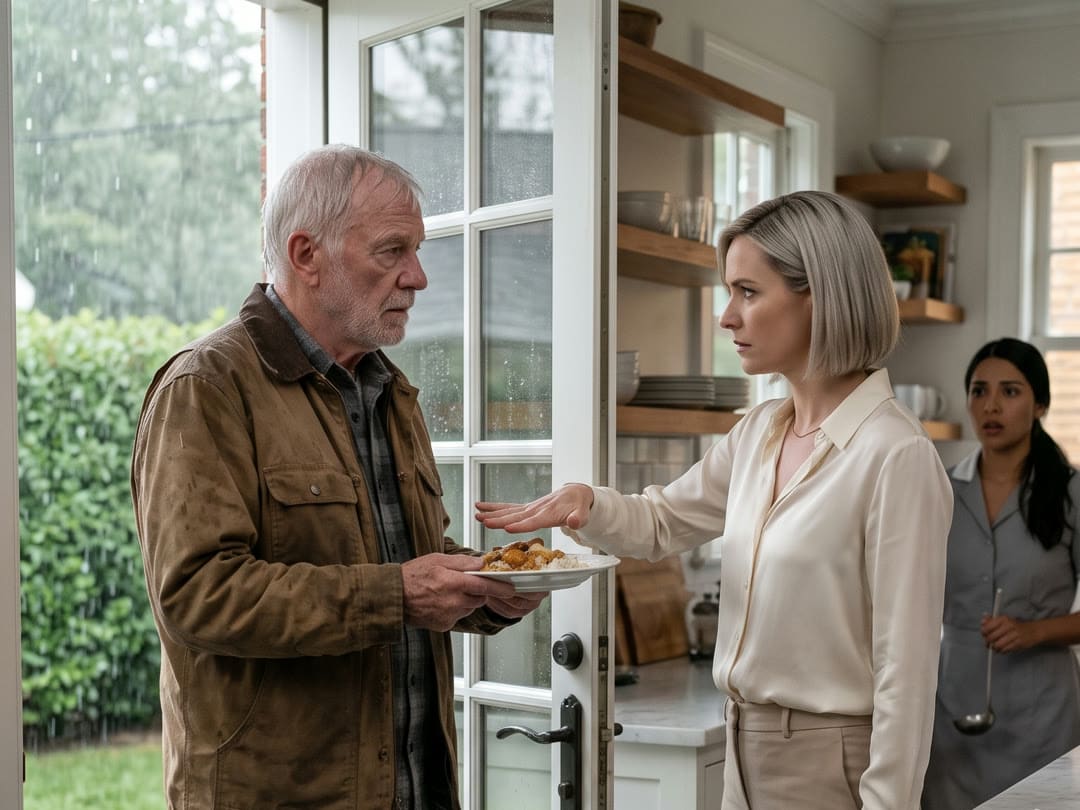
She walked straight to me, put the flat of her hand under the edge of the plate, and shoved it up and out of my hands.
It turned over in the air and hit the slate.
It broke in three pieces.
Stew and rice went across the tiles and over the toes of my boots.
She never touched me.
She didn’t need to.
“We don’t feed strays,” she said.
I stood there with my hands still out, as if the plate were still in them.
Steam came up off the floor.
Out on the step, the cat had flattened itself against the wall.
Carmen didn’t look at her boss.
She went to the counter by the window, picked up the dented blue lunch box, came back, and knelt on the wet tiles beside the broken plate.
She held it up to me with both hands.
“Take mine, sir.”
I took it.
I didn’t know what else to do.
My hand was shaking so badly the latch rattled.
Celeste’s face went tight.
Her gold bangle slid down her wrist as she raised her arm and pointed past me, at the open door and the rain.
“You’re fired. Both of you, out.”
Carmen stayed on her knees.
I looked at the woman pointing at the door my wife had asked me for, the door her drawings had already turned into a wall.
I said it quietly.
The way you tell a man the beam he’s standing on is yours.
“I built this kitchen for my son. Hello, daughter-in-law.”