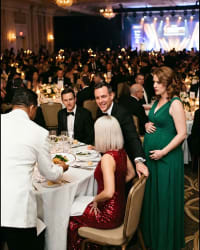
Grant came home a little after midnight.
I was sitting at the kitchen table under the one light over the stove, with a mug of decaf I hadn’t touched.
The ultrasound print stood against the sugar bowl in front of me.
He stood in the doorway for a long time.
He still had his birthday suit on.
The collar was open and his tie was gone, the way it always was by the end of a night.
“You set me up,” he said finally.
“I gave you the seat beside me,” I said.
“I wrote your name and mine on two cards and put them next to each other. That’s all I did.”
“You knew. You knew for days, and you didn’t say anything.”
“Ten days,” I said.
“You’ve been going for twelve Tuesdays.”
He opened his mouth.
Closed it.
He looked at the floor, and then at the refrigerator, where the clinic’s appointment card was held up by a magnet shaped like a lemon.
“It was closure,” he said.
“With Simone. It wasn’t supposed to be anything. We had history. You wouldn’t understand.”
“You’re right,” I said.
“I don’t understand how a man flicks his pregnant wife’s name down a table in front of his mother.”
He flinched at that.
Just slightly.
His jaw moved.
He looked at the scan against the sugar bowl.
“A boy,” he said.
“A boy.”
He took one step toward the table and reached for the picture, slowly, the way you’d reach for a bird.
I slid it across the wood toward me and put my hand over it.
“Can I at least have a copy?” he asked.
“You had the original,” I said.
“You laughed at it.”
He sat down across from me and put his head in his hands.
His shoulders shook once.
For a moment I thought he might cry, and I felt nothing about it.
That scared me more than anything else that night.
“What do you want me to do?” he asked into his hands.
“Pack a bag,” I said.
“Go to Neil’s.”
He looked up.
“This is my house.”
“It’s our house. Tonight it’s mine. Go to Neil’s.”
He went upstairs.
I sat at the table and listened to drawers open and shut over my head.
The closet door.
The zipper of the big gray duffel we’d taken to Maine on our honeymoon.
When he came back down, he stopped at the front door with his hand on the knob.
“You didn’t have to make it a show,” he said.
“You made it a show,” I said.
“I just stopped covering for it.”
The door closed.
His headlights swept across the kitchen wall and went away.
Neil texted me at seven the next morning.
“He’s here. The basement was already made up. I’m so sorry. I should have said something at the table. I’m not defending him.”
I read the message twice.
Already made up.
I didn’t know yet what that meant.
On Sunday morning I tried to finish the crib.
I don’t know why.
I think I needed one thing in that house to be done.
The side rails had been leaning against the nursery wall since August, next to a bag of screws and a little hex key.
I sat on the carpet with the instructions spread open.
Step 7.
Step 8.
My belly was in the way of everything.
I had to lean back on one hand to see the holes.
The third screw wouldn’t go in.
I turned it and turned it, and it slipped, and the side rail fell flat on the carpet with a soft thud.
That was all.
A rail falling over.
I sat there looking at it.
And then something in my chest just gave way.
I cried the way I hadn’t let myself cry in the car.
Loud.
Ugly.
Bent over my own knees as far as the baby would let me.
I said things out loud to an empty room that I’m not going to write down.
The baby kicked and kicked.
I put my hand over the spot and kept crying into my other arm.
I don’t know how long it lasted.
Long enough that the light moved across the carpet.
The front door opened downstairs.
Tessa, my best friend since college, has a key.
She called my name once, then came straight up the stairs.
She stood in the doorway of the nursery for one second.
Then she sat down on the carpet next to me, put her arm around my shoulders, and didn’t say a single word.
We sat like that until my breathing slowed down.
She smelled like rain and the lemon hand cream she always buys in bulk.
Then she picked up the hex key.
“Okay,” she said.
“Step 8. Hold this rail.”
We finished the crib together.
It took forty minutes.
When the last screw went in, she shook it hard with both hands, and it didn’t move.
“See?” she said.
“Some things hold.”
Then she pulled a sticky note out of her jacket pocket and stuck it on the crib rail.
A name and a phone number.
“She did my sister’s divorce,” Tessa said.
“She’s calm. She’s expensive. She’s worth it.”
I looked at the sticky note for a long time.
Before Marcus called, I’d thought my choices were to believe Grant or to be the jealous wife.
That was the whole menu.
Now I could see the rest of the room.
“I’m not going back to the far end of the table,” I said.
“No,” Tessa said.
“You’re not.”
Patricia called that afternoon.
“Rachel, honey,” she said.
Her voice was thick.
“I don’t know what to say.”
“You laughed,” I said.
“When she took the picture. You laughed.”
There was a long silence on the line.
I could hear her kitchen clock ticking.
I’d sat in that kitchen a hundred times.
“I did,” she said.
“I’m ashamed of that. I thought it was a silly joke between them. I didn’t know what I was looking at.”
“Neither did I,” I said.
“For a long time.”
She told me Simone had called her that morning, crying, calling her “Mom,” the way she had since she was twenty.
“I told her not to call me that anymore,” Patricia said.
“I should have told her four years ago.”
On Monday morning I called the number on the sticky note.
I said, “I’d like to file for divorce,” and my voice didn’t shake.
I was proud of that for the rest of the day.
That afternoon, Marcus messaged me.
“Filed this morning. She’s staying with her sister. I’m sorry this is how we got to know each other.”
“Me too,” I wrote.
“But I’m glad it was you who called.”
“I almost didn’t,” he wrote.
“I sat in the car outside that hotel for an hour trying to decide whose life I was about to ruin. Then I remembered you were pregnant. I figured you’d want to know before the baby came, not after.”
He was right.
I would.
The lawyer was kind and very calm.
She explained what happens next, slowly, the way you explain things to someone whose life has just been moved to the far end of a table.
Three weeks later, Grant rang our doorbell.
He was holding sunflowers.
My favorite.
He had shaved badly, and there was a small cut on his chin.
Neil’s car idled at the curb.
“Simone won’t take my calls,” he said.
“It’s over. With her. I swear to God, Rach, it’s done. I want to come home.”
I stood in the doorway with one hand on the frame.
I looked at the sunflowers.
I looked at the cut on his chin.
“She ended it,” I said.
“Didn’t she.”
He didn’t answer.
His eyes went to the doormat.
“You stood up in front of your mother and your brother and your oldest friends,” I said, “and you toasted the family you always come back to. You were looking at her when you said it. Eleven people heard you.”
“I’d had a lot to drink.”
“Nobody had a sip, Grant. Marcus walked in before anyone could drink.”
He opened his mouth, and nothing came out.
“You don’t get to come back to me,” I said, “because she has nowhere to put you.”
I closed the door.
Not hard.
Just all the way.
Through the side window I watched him stand on the porch for a while with the sunflowers hanging upside down from his hand.
Then he walked back to Neil’s car and got in the passenger side.
He signed the papers in November.
He didn’t fight.
He asked for every other weekend once the baby was old enough, and for the grill.
I gave him the grill.
The weeks after were quieter than I expected.
People from the dinner reached out one at a time.
Jamal wrote me a long, clumsy email that started “I don’t know how to say this” and never quite said it.
Amara sent white tulips with a card that read only, “We should have stood up.”
Nobody mentioned the laughter.
I didn’t either.
I didn’t need to.
In November, Tessa threw me a baby shower in her backyard, under a rented white tent with patio heaters that smelled faintly like toast.
I told her to invite Patricia.
I wasn’t sure I meant it until the RSVP came back with “Yes, thank you” in her careful slanted handwriting.
She arrived early, the first one there.
She brought a tray of lemon bars, her specialty, and stood at the edge of the tent holding it with both hands, like she was waiting to be told where to go.
Tessa had set one long table for lunch.
At the head of it was a chair with a green ribbon tied around the back.
Mine.
Patricia put the lemon bars down, walked to the far end of the table, and pulled out the last chair.
“Patricia,” I said.
“Come sit by me.”
She stopped with her hand on the chair.
She looked at the seat beside mine.
Then at me.
Her chin started to tremble, and she pressed her lips together hard to stop it.
“I don’t deserve that seat,” she said.
“Nobody earns a seat by deserving it,” I said.
“You sit there because somebody saves it for you. Come on. My feet hurt.”
She walked up the table and sat beside me.
Halfway through lunch she reached over and squeezed my hand under the tablecloth, and she didn’t let go until the cake came out.
It was a small white cake.
Tessa had found a little gold clip holder for the top, just like the one on the birthday cake.
I didn’t put a picture in it.
I left it empty, on purpose.
Some things you only need to say once.
Everyone at that table already knew it was a boy.
Simone sent me one message, in late November.
It was short.
“I’m sorry about the picture. That was cruel. I think I wanted to be the one he came back to so badly that I stopped seeing you as a person.”
I read it twice, standing at the kitchen counter.
I didn’t answer.
Not to punish her.
I just didn’t have anything to say that would make either of us better.
Patricia told me later that Simone wasn’t at Thanksgiving that year, for the first time in eleven years.
Nobody set her a place.
Patricia said she kept looking at the spot between the two chairs where it used to be.
Grant wrote me a letter around the same time.
Real paper, his handwriting, two pages, slanted the way his mother’s is.
Most of it was about turning forty.
About feeling like his life had happened without him.
About how Simone made him feel twenty-five again.
One line near the end was about me.
“I moved your card because I wanted to feel like I could have both. I’m sorry you had to watch me choose.”
It was the first honest thing he had said to me in months.
It was also too late by about twelve Tuesdays.
I folded the letter and put it in the drawer with the baby clothes.
I didn’t throw it away.
Someday, our son might want to know his father was capable of one honest sentence.