Chapter 1
Layton Street is short.
It has eleven houses, and only two on my side.
Mine is the small white one with the green door.
The other is brick, taller than mine, with black shutters and a garage that holds more than it should.
My name is Rose Mercer.
I am seventy-four years old.
I have lived in that white house for forty-six years.
I raised a son in it, and I buried a husband from it.
Harold died four winters ago, in February, in the front bedroom.
Since then I do not sleep much.
Some people lie awake and stare at the ceiling.
I sit in the chair by my front window with a blanket on my knees.
I watch the street.
There is nothing else to do at three in the morning.
I know every car on Layton by its headlights.
I know the paper boy’s bicycle and the raccoon that goes through the Hendersons’ trash.
I tell you this so you understand something.
I am not a nosy woman.
I am only a woman who is awake when the rest of the street is not.
On Sundays I go to my son’s house for dinner.
It takes two buses and a walk.
I leave at three, and I am never late.
That Sunday I put on my good gray cardigan, the one with the darned elbow.
I wore the lavender blouse under it, and my wedding band, which I have not taken off since 1971.
I baked an apple pie.
I carried it in the same dented tin I have used since Harold was alive.
The tin has a thumb-sized dent in the lid.
Harold did that with a hammer in 1988, by accident, while fixing the porch.
I could not throw it out.
I never have.
My son’s house sits at the top of a hill in a neighborhood where the lawns look combed.
Garrett is forty-six.
He is an accountant, and a good one.
He has his father’s shoulders and his father’s way of going quiet when something is wrong.
He reads every statement that comes in the mail, every line.
He is a decent man.
I want to say that now, before the rest.
Garrett married Vanessa eleven years ago.
She is forty-one, tall, and very polished.
Her hair is never out of place, and I have never seen her carry a shopping bag she did not mean to be seen carrying.
She has never once called me anything but Rose.
Not Mom, the way Garrett asked her to.
Not Mother Mercer, the way my own sister’s husband was taught to say it.
Just Rose, in a bright voice, as if I were the woman who delivers the flowers.
I do not hold it against her.
A name is only a name.
What I noticed, slowly, was the chair.
Three years ago, my seat at their Sunday table was at Garrett’s right hand.
He put me there himself.
The next year it was in the middle, between a neighbor and an aunt of Vanessa’s.
Last month it was the chair beside the kitchen door, the one that catches the draft when the cook goes in and out.
Nobody said anything.
Each time, it was explained to me in a perfectly reasonable way.
“We’re expecting a full table, Rose.”
“Bradley’s knee, you understand.”
“It’s easier for you, near the kitchen.”
I always said the same thing back.
“That’s fine, dear.”
My mother used to say that a quiet table is cheaper than a loud one.
She raised four children on that rule, and she was not wrong.
So I sat where I was put, and I ate, and I went home on the bus.
There was one other thing, and it was on my kitchen table.
Beginning in the spring, I had received letters.
Cream-colored envelopes, heavy paper, from a company called Brandt Holdings.
They wanted to buy my house.
The first one was polite.
The second was friendlier.
By the fourth, the numbers had gone up, and a line at the bottom said, “For questions, your family contact is V. Mercer.”
I read that line three times at my kitchen table.
I had not asked anyone to be my family contact.
I put the letters in the biscuit tin on top of the refrigerator and said nothing.
That was my way.
It was always my way.
I thought it was only a kindness, Vanessa taking the trouble, and that I was being old and suspicious.
I thought a good deal of foolish things that spring.
Then came last Thursday.
I was in my chair by the front window at about two in the morning.
A car turned onto Layton Street with its lights low.
It did not go past the Hendersons’.
It did not turn around at the end.
It pulled in at the brick house next door and cut its engine.
It was a silver car, and I knew it, because I had watched it back out of my son’s driveway every Sunday for three years.
A dent in the rear bumper, and a round sticker in the back window.
A green cartoon dinosaur, the kind a boy of eight puts on his mother’s car as a joke.
The porch light of the brick house came on.
A man opened the door.
He did not say anything, and neither did she.
She went in, and the door closed.
I sat there with the blanket on my knees and my heart going very slowly, like a clock about to stop.
At six in the morning, when the sky went gray over the Hendersons’ roof, the door opened again.
She walked out.
She sat in the car for a long moment with her head back against the seat.
Then she drove away, with her lights still low.
I did not sleep after that, not that I ever do.
I told no one.
I did not tell Garrett, and I did not tell my sister in Ohio.
I was not certain it was mine to tell.
I was seventy-four years old, and a woman my age is easily called confused.
I only knew what I had seen, and I knew the car.
On Sunday I went up the hill at five o’clock with the pie in both hands.
Wyatt opened the door before I could knock.
He is eight, and he has been watching for me from the window since he was three.
He wrapped both arms around my waist and pressed his face into my cardigan.
“Grandma. You smell like cinnamon.”
“That would be the pie,” I said.
“No,” he said, very seriously.
“It’s you.”
I kissed the top of his head.
His hair is sandy, like his father’s was at that age, and it stood up in the back.
The house was warm and bright, and smelled of roast beef and candle wax.
Vanessa’s candles are always the first thing you see.
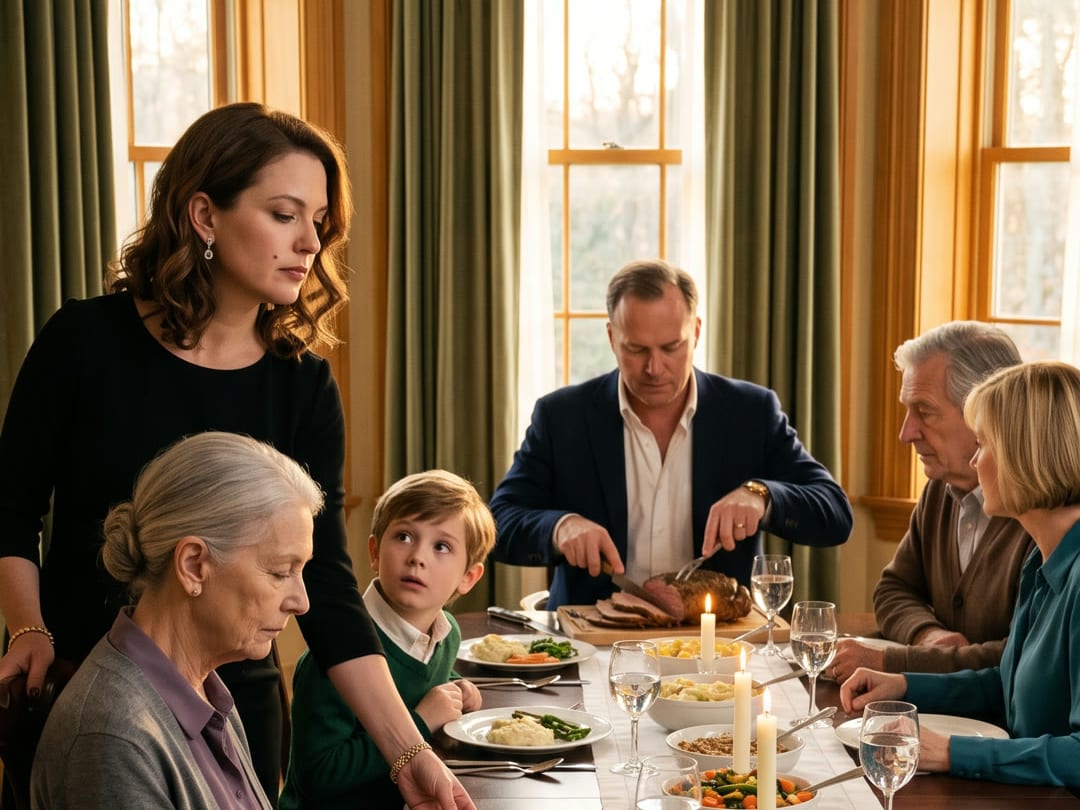
Tall white ones, in glass, down the middle of a table long enough to seat sixteen.
The late sun came through the tall windows and turned the dark wood honey-colored.
The linen was white as a sheet on a line.
There were people I did not know well.
Two of Garrett’s partners from work, with their wives.
Bradley and Carol Dunmore, from three doors down.
Vanessa’s aunt Pauline, who does not hear well and talks loudly to make up for it.
Their faces turned toward me when I came in, then turned back.
Garrett stood at the head of the table with a carving knife in his hand and a roast in front of him.
He looked up and smiled, a real one, tired around the eyes.
“Mom,” he said.
“You made it.”
“I always make it.”
“Sit anywhere,” he said, and then, because he is Garrett, he pointed.
At the chair by the kitchen door.
I carried my pie to the sideboard and set it down.
The dented tin looked very plain next to Vanessa’s crystal.
I was in my gray cardigan with the darned elbow, among black silk and gold watches.
I did not mind.
I have been the plain one in a good many rooms.
I pulled out the chair by the kitchen door.
The draft came across my ankles.
Wyatt took the seat beside it.
He had put himself there, on purpose, at the end of the table, between me and the wall.
He is eight.
He does not know yet how much he is telling the world.
Vanessa came out of the kitchen in a black dress, narrow and tailored, with diamonds in her ears and a gold bracelet on her wrist that I had not seen before.
I noticed the bracelet.
It was new, and it was heavy, and it caught the light every time she moved.
She was carrying a plate.
She walked around the long end of the table, past the aunt and past the partners, in her good heels, the plate balanced in one hand.
She came up behind my chair.
“Rose,” she said, and then she stopped, and I felt it, the way you feel weather.
She was not speaking to me.
She was speaking to the table.
She put her free hand on the back of my chair.
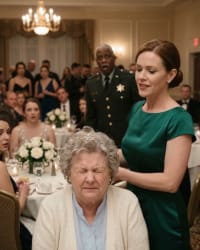
She lowered the plate onto the placemat in front of me, a plain white plate with a small helping of mashed potatoes and some green beans.
It made a soft clink against the table.
Then she lifted her chin, and in a voice that could have reached the street, she said it.
“Eat fast. Guest needs your seat.”
Every head at the table turned.
The candles burned straight and still.
Somewhere in the kitchen, a timer ticked.
I did not move.
I looked at the plate.
It was warm.
The potatoes were very smooth, and I thought, with a strange sort of calm, that she had made them herself.
I had no appetite.
My hands lay on the white linen, rough against it, and I looked at them as if they belonged to someone else.
I heard Carol Dunmore draw in a breath.
I heard Aunt Pauline say, too loudly, “What did she say?”
Nobody answered her.
Garrett had the knife in the roast and had not moved it.
He was looking down the table at the plate and then at his wife, and his face was the face of a man who did not quite follow.
Wyatt’s small hand found my sleeve under the table.
I did not answer Vanessa.
I did not say anything at all.
There is a kind of silence that is not weakness.
My husband taught me that.
I lifted my head and looked across the table at Vanessa.
I did not whisper.
I said it in my own voice, calm and clear, loud enough for every chair to hear.
“Vanessa, whose house was your car at all Thursday night?”
I did not say it to be cruel.
I said it as plainly as I would have asked the time.
The room went silent.
Wyatt’s eyes went to his mother.
Vanessa’s mouth went to a tight flat line, with a thin little smirk on it, and she looked around the table to bring the others in.
“You must be thinking of someone else’s car.”
She said it to the guests, not to me.
She tilted her head, as if I were a sweet old woman who had mixed up the days.
“Rose gets her days mixed up,” she said, to no one in particular.
Aunt Pauline nodded, as people do when they have not heard.
I did not look at the table.
I looked at Vanessa.
I looked at her the way you look at a clock you have stared at all night.
There was no anger in it.
I picked up my fork, and I ate a small bite, and I said it calmly.
“I know your car. Same one outside the brick house on Layton, all night Thursday.”
I did not raise my voice.
I have never needed to.
The room went quiet in a new way.
It was not the silence of embarrassment.
It was the silence of people who have heard a street name they know.
Down at the head of the table, the knife stopped moving.
Garrett had lifted his head.
I saw his eyes go from me to the plate, from the plate to his wife’s hand on my chair, and from her hand to her face.
“Layton,” he said, not to anyone.
He said it slowly, the way a man tests ice.
“Thursday.”
He turned in his chair until his whole body faced her.
“Thursday?” he said.
“You told me you were at your sister’s.”
Nobody breathed.
I took another bite.
I do not know why.
My hands needed something to do, and the potatoes were warm, and I was seventy-four years old and I had come a long way on two buses.
I took a small bite.
It was good, as it happened.
She does make a good potato.
I chewed, and I swallowed, and I did not look up.
I heard a chair scrape.
I heard a breath that was nearly a sound.
When I raised my eyes, Vanessa was standing behind my chair with her hand still on the wood.
Her face had gone the color of the linen.