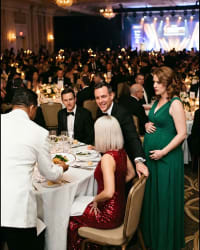
The room emptied slowly.
People do not leave a scene like that in a rush.
They linger at the coat rack, and they look for a reason to look back.
I sat in the chair Lucas brought me, at the end of the hall, with a glass of water I couldn’t drink.
My hands wouldn’t stop.
I pressed them flat on my belly and felt my daughter turn, a slow heavy somersault, as if she were checking that I was still here.
“I’m here,” I told her, very softly.
“I’m here.”
A few guests stopped as they passed.
One of the wives, a small woman in green, bent down and touched my shoulder.
“I’m so sorry,” she whispered.
“We didn’t know. None of us knew.”
“I believe you,” I said.
It was true.
They had been told a story, and they had enjoyed it, and I could not blame them for that.
Another man, one of the clients, shook my hand without a word and left a card on the table.
A younger woman, a stranger, only squeezed my fingers.
Then they were gone, and the Alder Room grew quiet.
The servers cleared the long table.
They worked in silence, stacking plates, blowing out the candles one by one.
Nobody touched the cake.
It sat on its side table, five or six candles burned halfway down, the frosting beginning to sag.
I stared at it for a long time.
“Lucas,” I said.
“Yes, Ms. Hart?”
“Please call me Elise.”
He considered this carefully.
“I’ll try,” he said.
“It may take a few weeks.”
I laughed.
It cracked in the middle and became something else.
He didn’t look away.
He stood beside my chair with his hands folded behind his back, exactly as he had the first morning, and he waited until it was over.
Then he handed me a clean napkin.
“Dennis called,” he said.
“He heard from someone on the street. He’s on his way.”
“Of course he is,” I said.
I heard the front door open below, and a man’s voice, wavering.
I heard the stairs.
Dennis Cole came up them like a man in a hurry who is also afraid of what’s at the top.
He is a short man, with a round face, and he had not shaved.
He wore a rumpled raincoat over a pajama top.
He stopped in the hall and looked at me, and then at the empty room, and then at the cake.
“Oh, Lisey,” he said.
“Hi, Dennis.”
“Did he, did he really?”
“In front of everyone.”
He sat down on the bench beside me, heavily, and took my hand in both of his.
We didn’t say anything for a while.
“Carol would have thrown a plate at him,” he said finally.
“I considered it.”
“What stopped you?”
“I’m too tired to aim,” I said.
He started to laugh, and then he was crying, and I was crying, and the two of us sat in the hall of the Alder Room holding on to each other like people in a boat.
When we let go, a small figure was standing at the top of the stairs.
It was Vanessa.
She had put her coat on.
Her mascara had run in two dark lines, and she was holding her phone against her chest.
“I’m sorry,” she said.
“I’ll go. I just wanted to say something.”
Lucas started forward.
I lifted my hand, and he stopped.
“Say it,” I said.
She came a few steps closer.
She stood in front of me, small and young and shaking, in a dress that cost more than my first car.
“I didn’t know you were pregnant,” she said.
“He told me the baby wasn’t his. He said you’d been with someone else. He said you were unstable.”
“I’m sure he did.”
“I believed him,” she said.
“I wanted to.”
“I know.”
She looked at the floor.
She seemed to be gathering something.
“I have something on my phone,” she said.
“I didn’t know what it meant until tonight.”
She held it out.
I didn’t take it.
I looked at Walter, who had come up beside me, and he nodded.
“It’s a voice memo,” Vanessa said.
“From a few weeks ago. He sent it to me by accident. He meant to send it to someone else.”
Walter took the phone from her, gently, and pressed the play button.
Mark’s voice filled the narrow hall.
It was relaxed and amused, the voice he used with friends.
It came from a car, with the engine running.
“Don’t worry about the house,” Mark said.
“After the baby comes, she’ll be a zombie. I’ll slide the papers across the kitchen table at three in the morning and she’ll sign whatever I put in front of her. She always does.”
There was a pause, and the sound of a turn signal.
“Her signature’s easy anyway,” he said.
“I’ve been doing it for years.”
Walter stopped the recording.
Nobody spoke.
I didn’t cry.
I felt something else, something cold and clear, like water at the bottom of a well.
It wasn’t surprise.
I think I had known.
But there is a difference between knowing a thing and hearing it said in a voice you love, with a turn signal ticking in the background.
“Ms. Pryce,” Walter said quietly.
“Would you be willing to give a statement?”
“Yes,” Vanessa whispered.
“It would help my client very much.”
“I’ll do whatever you need,” she said.
“I just want to say, I’m sorry. I didn’t know. I’m so sorry.”
I looked at her.
She was twenty-nine, thirty, maybe thirty-one.
She had been lied to just as I had, in a different room, with a different story.
“Vanessa,” I said.
“Please send that file to Walter tonight. And get yourself home safely.”
“Thank you,” she said.
She turned and went down the stairs.
Her heels were slower than they had been coming up.
Walter looked at the phone in his hand, and then at me.
“That’s the whole case,” he said.
“He signed the settlement tonight. If he ever tries to contest it, this ends him.”
“I don’t want it to end him,” I said.
He raised his eyebrows.
“I want it to end it,” I said.
“That’s all. The marriage. The lie. The signature.”
“Elise,” Walter said, and for the first time he used my first name.
“You are the calmest person I’ve ever met.”
“I’m not calm,” I said.
“I know,” he said.
“You’re saving it.”
I leaned back in the chair and closed my eyes.
Downstairs, the kitchen was starting to pack the food.
I could hear the clink of containers.
I could hear Lucas giving quiet instructions.
I could hear the Alder Room, in its own slow language, beginning to belong to me.
Mark moved his things out that same night.
Walter arranged it.
Two movers came at ten, and a locksmith at eleven, and by midnight my husband’s clothes sat in six cardboard boxes on the porch, with a note from the lawyer on top.
I wasn’t there.
I slept, for the first time in months, in a small room above the restaurant, on a cot Lucas found in the storeroom.
I woke at dawn to a gray window and the smell of bread.
For a moment, I couldn’t remember anything.
Then I remembered all of it.
I lay very still, with my hand on my belly, and waited for the weight.
It didn’t come.
Something else did.
It was a small, strange lightness, like when a fever breaks.
The bank received my call at nine that morning.
I told the woman what I had told her the first time, and then I told her the rest.
I told her about the signature, the settlement, and the voice memo.
She listened.
When I finished, she was quiet for a moment.
“Mrs. Dunmore,” she said.
“I’m very sorry this happened to you.”
“Thank you.”
“The line of credit will be frozen today. The funds will be recovered from the account of the borrower.”
“Is it going to the district attorney?”
“That is up to the bank’s compliance team,” she said carefully.
“But I’ll tell you, with a signed settlement and an admission on record, they usually prefer to resolve it quietly.”
I thought about that.
“Fine,” I said.
“As long as he never touches my name again.”
“He won’t,” she said.
He didn’t.
I heard from Gordon Fenwick the following week.
He sent a handwritten letter, on heavy cream stationery, to the restaurant.
He said Mark had been dismissed for cause.
He said the firm had reviewed every expense report Mark had filed in the last two years, and had begun to repay the clients he had overcharged.
He said he was sorry.
He said he should have looked closer.
At the bottom, in a different pen, he had written: “If you ever need an accountant who knows how this ends, I know a good one. Come to dinner, Mrs. Dunmore. On me, if you’ll allow it.”
I took the letter downstairs and showed it to Lucas.
“Put it on the board,” I said.
“The board?”
“Where we keep the things that make us smile.”
He pinned it between a photograph of Dennis and Carol and a child’s drawing of a fish.
My daughter was born eleven days later.
It was a cold bright morning, the kind Chicago gives you in late October, with a wind off the lake that makes the whole city ring.
I had spent the night before in the dining room, helping Lucas fold napkins.
At four in the morning, my water broke on the hardwood floor, right under the chandelier.
“Ms. Hart,” Lucas said, very calmly, “I believe it’s time.”
“Elise,” I said, between breaths.
“Elise,” he said.
It was the first time he had said it.
He said it like a man learning a new word.
“Don’t move. I’ll call a cab.”
“Call Dennis too.”
“He’s already on the stairs.”
He was.
He came up from the kitchen with a thermos and a blanket, in his pajama top and raincoat.
I had a long labor.
It was nine hours of the hardest work of my life, in a bright room on the north side, with Dennis in the waiting area and Lucas pacing the hall.
At two in the afternoon, a nurse put my daughter in my arms.
She had a full head of dark hair, and a furious red face, and she stared up at me with eyes the color of storm clouds.
“Hello,” I said.
She screamed.
“Yes,” I said.
“I know.”
I named her Ruth, after my grandmother.
We call her Ruthie.
Dennis came in an hour later, holding a bunch of yellow tulips and weeping before he reached the bed.
He held her for twenty minutes without saying a word.
Mark never came.
He sent one message, three days after the birth, through his lawyer.
It said that he wished the child well.
It didn’t mention the signature.
It didn’t mention the house.
I read it once, and I folded it, and I put it in the blue folder in the linen closet, under the baby towels.
I don’t hate him.
I thought I would.
I braced for hatred the way I had braced for the weight.
But when I look for it, I find mostly a long gray tiredness, and underneath it, very faint, a little grief for a man I thought I knew.
I hold that grief the way you hold a stone from a beach.
It’s smooth.
It no longer cuts.
The Alder Room reopened in December.
We changed almost nothing.
Same cream walls, same chandelier, same table by the window where Dennis and Carol used to sit.
Dennis stayed on as host.
He says he’s retired, but he comes in every day at four and straightens the silverware.
Lucas runs the floor like a ship.
He has learned to call me Elise about half the time.
I do the books, because I am a bookkeeper at heart.
I do them in the little office behind the bar, with the safe, and the hook where the brass key ring hangs every night.
On the windowsill of the upstairs room, in a terra-cotta pot, stands a lemon tree.
I found it in my grandmother’s backyard in Evanston, in the spring, a stubborn little thing that somehow survived the winter.
I carry it indoors every November, and I think of her.
“A woman should always own one door,” she told me.
I own a door now, with a green awning and a brass handrail, and a hundred steps I have climbed.
On the first night after the reopening, the dining room was full.
Ruthie slept in a basket behind the bar, wrapped in a yellow blanket, with Lucas’s folded jacket under her head.
I stood at the top of the stairs, in my navy dress, and watched the room glow.
Forty faces, laughing under the chandelier.
A waiter lifting a tray.
A candle in every window.
Nobody blocked the door.
I thought about the woman who had climbed those stairs that first night, eight months pregnant, with her hand on her belly and her heart in her throat.
I wanted to tell her it would be all right.
I wanted to tell her she would not need to be calm forever.
I think she knew.
I think she had known all along that the key in her hand was only a key, and that the door had always been hers.
Some people have told me I was cruel.
They say I should have waited for a private moment.
They say I embarrassed him in front of his boss, his team and his friends, and that no one deserves to be humiliated that way.
Others have said I was too gentle.
They say a forged signature and a lie to a pregnant wife deserved a courtroom, not a settlement.
I have turned it over a hundred times, in the quiet hours after closing, with Ruthie asleep against my shoulder.
I still don’t know which of them is right.
So I’ll ask you.
Was I too hard on him, or not hard enough?